21 September 2026
15 September 2026
14 September 2026

14 September 2026
14 September 2026
The target readers of this article are investors and entrepreneurs who want to open a play café or indoor playground. In 2026, the family entertainment market will continue to expand, but the truly profitable venues rely not only on equipment, but also on the right design strategy from the beginning. This full design guide will cover all the key links from space planning to ROI.
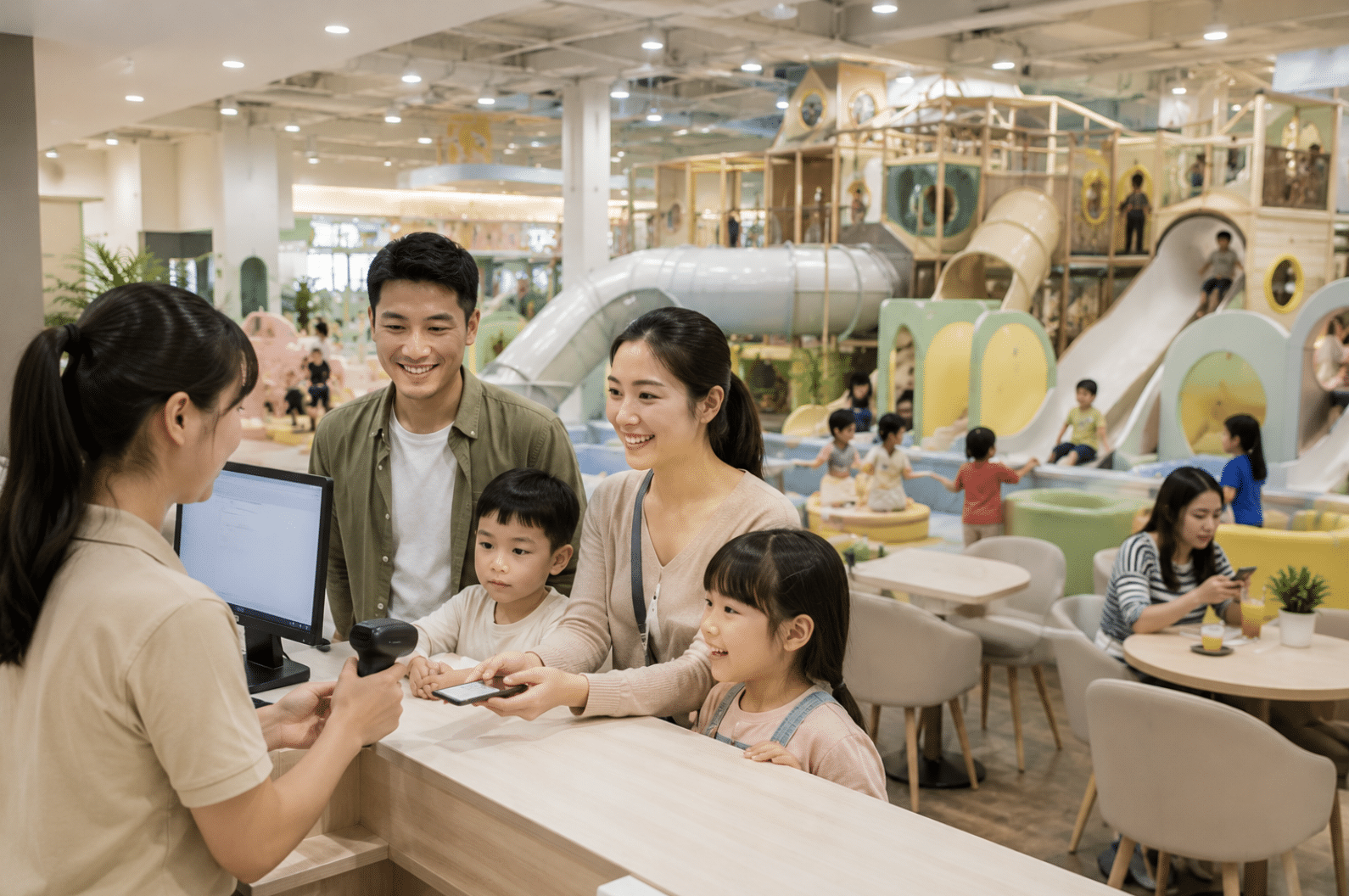
Play café is a business model that combines children’s play area and café. Parents bring their children to play. The children are active in the soft play zone or toddler zone, and the parents drink coffee and eat next to them. This model solves a real pain point: parents don’t want to just wait next to them. They need a comfortable space.
Compared with traditional indoor playground, the core advantage of play café is that per-customer spending is higher – the same guest consumes both admission fee and food and beverage.
A standard play café business model usually has the following sources of income:
In 2026, there are several underlying logics of play café’s profitability:
First, the demand for screen-free entertainment continues to grow. More and more parents take the initiative to find activities to make their children leave the screen, and indoor play just meets this demand.
Second, year-round operation. Unlike outdoor playgrounds, play café is not affected by the weather. Rainy days, winter vacations and summer vacations are all peak seasons, and there is no real off-season.
Third, multiple income structures. It is difficult to make a profit just by relying on the admission fee, but play café superimposes the café revenue, and the single customer’s consumption is significantly increased.
Fourth, birthday party economy. Birthday party is one of the most stable sources of high gross profit income for play café. A party room can run 3-4 games on a weekend.
Fifth, the membership model brings predictable recurring revenue and reduces dependence on weekend traffic.
According to IAAPA’s industry data, the indoor family entertainment market is still in the global expansion stage, especially in the context of the repositioning of urban areas and shopping malls, and the location opportunities of play café are increasing.
Space planning is the most critical first step in the whole play café design. A wrong layout will directly affect customer flow, safety and revenue per square meter.
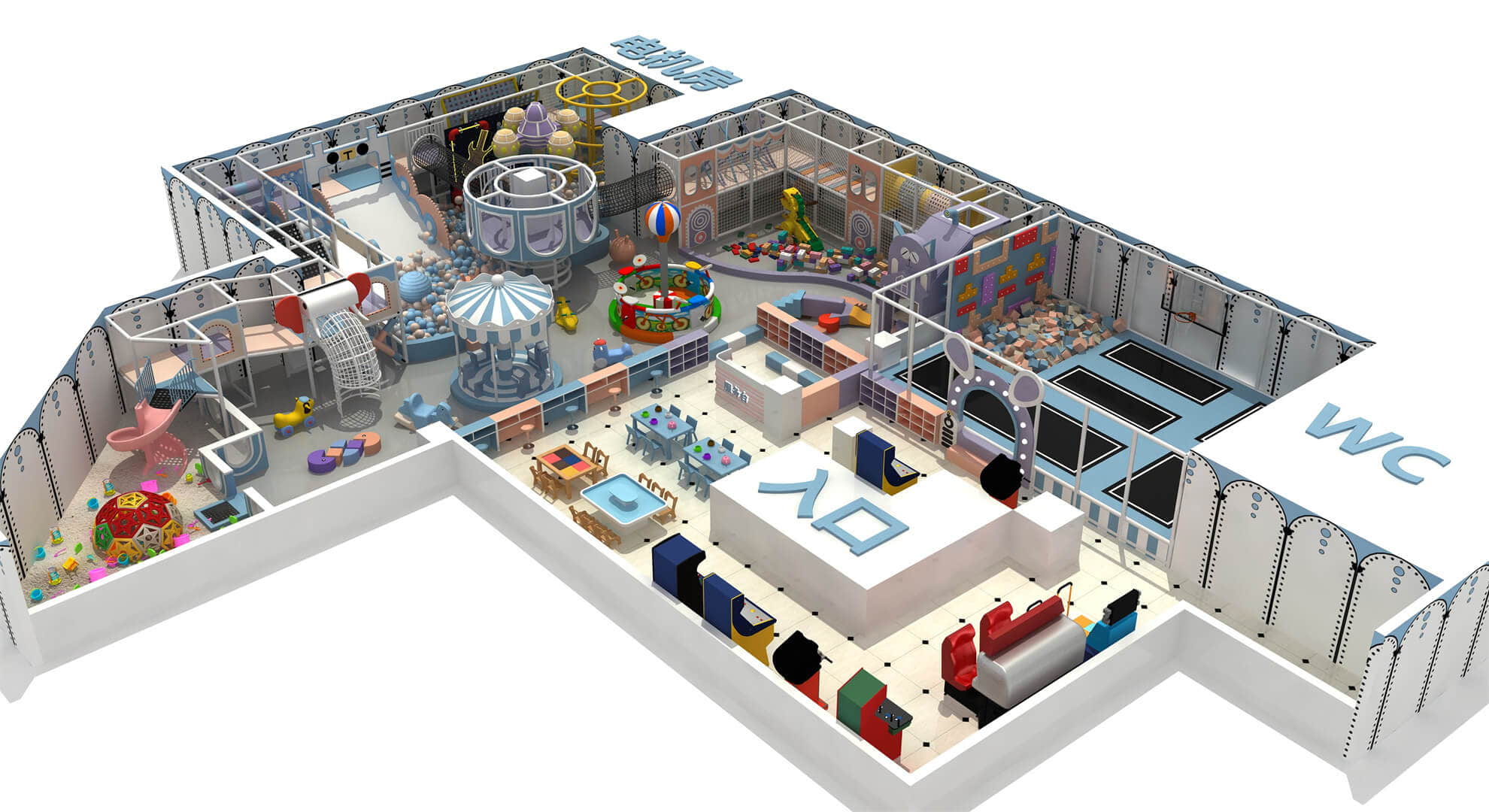
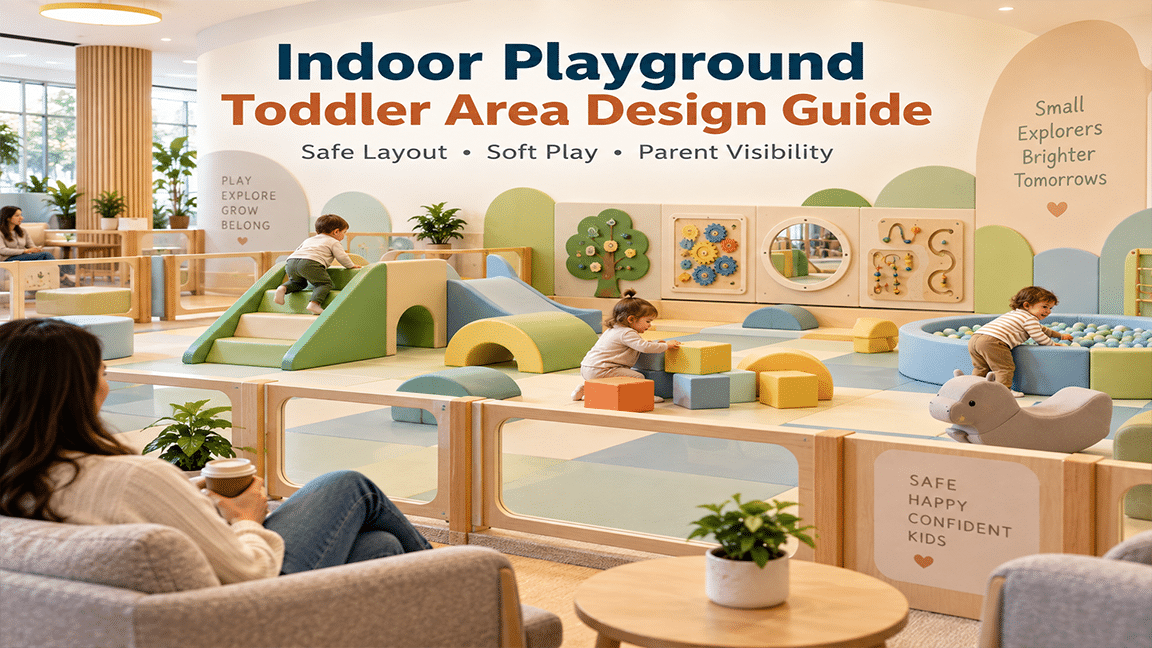
Play café layout with play zone, café seating area, toddler zone and party room
Basic principles:
For venues below 1000m2, it is recommended to place the toddler zone and main play area in the widest position, arrange the café seating along the edge, and place the party room in a relatively independent corner.
A complete play café usually requires the following zones:
Toddler Zone (0-3 years old)

Main Play Zone (3-12 years old)
Café Zone
Party/Events Room

The choice of Equipment directly affects three things: safety compliance, maintenance cost and customer appeal.
The core criteria for choosing play equipment:
For investors who plan to use turnkey solution, choosing a supplier that can provide full services from design to installation will greatly reduce the project risk. NanPlay provides one-stop services covering design, manufacturing, installation and after-sales support, suitable for new investors who do not have rich experience in venue design.
Safety is not just a matter of equipment, but also a part of the whole operational design.
Several levels that need attention:
Theme design is the core weapon of play café’s differentiated competition. In the same city, when there are more and more play cafés, those venues with distinct themes and atmospheres will have stronger word-of-mouth spread.
A few practical suggestions:
The start-up cost of opening a play café varies greatly, depending on the city, area, positioning and fit-out standards. The following is a reference interval for a medium-sized venue of 500-800㎡ :
| Project | Estimated Cost Range |
| Lease deposit & fit-out | $30,000 – $80,000 |
| Play equipment | $40,000 – $120,000 |
| Café equipment & fit-out | $15,000 – $40,000 |
| Interior design & theming | $10,000 – $30,000 |
| Permits & compliance | $5,000 – $15,000 |
| Technology (booking, POS, waiver) | $3,000 – $8,000 |
| Working capital (3 months) | $20,000 – $50,000 |
| Total | $123,000 – $343,000 |
The actual cost will fluctuate greatly depending on the regional and site selection. Choosing turnkey solution instead of finding multiple suppliers separately can usually save a lot in project management and time costs.
The income structure of a well-run play café is probably as follows:
In terms of gross profit margin, food and beverage is usually 60-70%, party packages can reach 50-65%, and admission is relatively low, because it covers equipment maintenance and staffing.
The key to making a profit is not to increase a certain income, but to make all income lines work at the same time. It is difficult for a venue that relies only on admission fee to make a profit, but the overall EBITDA margin of a venue that does café, party and membership can reach 15-25%.
Many play cafés have business problems in the design stage. Common mistakes include:
Many play cafés have business problems in the design stage. Common mistakes include:
1. The sightlines of Café and play area are covered.
If parents can’t see their children, they will not relax their consumption, and the café revenue will drop sharply.
2. Toddler zone without independent isolation
It is a safety risk for older children to mix with small babies, and it will also make parents with children feel insecure.
3. Party room is designed as a fixed decoration
Party room needs flexibility. Fixed-themed decoration will limit the use of scenarios. The movable decoration system is more practical.
4. The choice of equipment depends on the price, not the certification.
Cheap equipment may bring greater implicit costs in insurance and compliance.
5. Ignoring the staff flow staff needs to be able to move quickly between zones. If the layout design makes the staff’s movement route conflict with the customer flow, the peak hours will be very chaotic.
6. The quality of the café area is too low. If the café looks like an accessory, parents will not spend there, but only wait for their children. The design investment of Café directly affects F&B revenue.
Many investors will be confused at the beginning: whether to find a turnkey supplier all-inclusive, or find designer, equipment supplier and contractor separately?
| Turnkey Solution | Self-Design | |
| Project cycle | Shorter, less coordination | Longer, manage multiple suppliers by yourself |
| Cost control | Clearer quotation in adcance | Many variables, easy to exceed the budget |
| Design quality | Depend on supplier’s experience | Depend on the designer you find |
| Flexibility | Relatively low | Higher |
| Who is suitable for | New investors with no experience in venue design | Investors with experience or a professional team |
For investors who open a play café for the first time, the core value of turnkey solution is not only to save trouble, but also to reduce decision-making errors caused by lack of experience. The turnkey indoor playground solution provided by NanPlay covers from design consultation to installation and after-sales, which is suitable for investors who want to reduce the cost of exploration in the early stage.
Core factors affecting the profitability of play café:
Venues close to residential areas, shopping malls or suburban family neighborhoods have more stable passenger flow. The balance between rent and flow of people is the most critical judgment.
Converting one-time visitors into members is the most effective way to improve revenue predictability.
Party room is the area with the highest profit margin. If the high utilization rate can be maintained on weekends, it will have a great impact on the overall profit.
Staff is one of the biggest operating costs of play café. Reasonable scheduling and automation tools can control costs without affecting service quality.
It is difficult for a one-time visitor to support the long-term operation of a venue. To attract family repeat visits, events, seasonal themes and membership benefits need to be updated regularly.
Take a 600㎡ play café as an example, the reference data for 2026:
The above data is based on medium-sized cities, reasonable site selection and normal operation level. The actual ROI is greatly affected by location, pricing, party business proportion and membership conversion rate.
Generally speaking, venues with a good job of birthday party and membership will have a significantly faster return on their capital than those of venues that rely solely on daily admission.
Customer retention is the core of play café’s long-term profitability. The following are a few practical directions:
Establish a membership ecosystem
It’s not just a discount card, but also a member’s exclusive right and interest – member-only sessions, priority birthday booking, seasonal perks.
Regularly hold themed events
Glow night, holiday parties, character meet-and-greet – these events provide regular customers with a sense of freshness and an opportunity to attract new customers.
Collect and respond to customer feedback
Post-visit survey, Google review management, feedback loop – knowing what the guests are not satisfied with can improve before they leave.
Staff Training
Equipment can be copied, but staff attitude is difficult to copy. A friendly, professional and emergency staff team is one of the most important sources of customer loyalty.
App or CRM system
Record the visit frequency, consumption preferences and children’s birthdays of guests – personalized communication with data is much more effective than sending coupons in groups.
Q1: Is a play café profitable in 2026?
It can make a profit, but it is not an automatic profit. The key is the revenue mix – if the birthday party, membership and café revenue are all running normally, the overall profit margin can reach 15-25%. It is difficult for venues that rely on admission fee alone to cover the cost.
Q2: How much does it cost to open a play café?
It depends on the area, city and location. The start-up cost of a 500-800m2 venue is usually between $120,000 – $350,000. Site rent, equipment quality and interior fit-out standards are the three biggest variables that affect the cost.
Q3: What is the best layout for a play café?
There is no only answer, but the core principle is that the café area must have a clear sightline to the play zone, the toddler zone needs to be physically isolated, the party room needs to be independent, and the staff’s mobile route cannot conflict with the customer flow.
Q4: What equipment is needed?
The basic configuration includes: soft play structure, toddler play equipment, climbing elements and café equipment. According to the positioning and budget, ninja course, interactive games, sensory play elements, etc. can be added. All equipment must meet the requirements of local safety certification.
Q5: How do play cafés make money?
Mainly through admission fees, food and beverage sales, birthday party packages, memberships and private events. In a well-made venue, these five lines will run at the same time and promote each other – members are easier to book parties, and party guests are easier to convert into members.
The core of a profitable play café is not to buy the most expensive equipment or find the largest venue, but to think about the revenue logic clearly from the design stage.
Space planning determines customer flow and sightlines; zoning strategy determines which customers can serve; equipment selection determines safety compliance and repeat visit rate; theme design determines word-of-mouth communication; membership and party business determine long-term profitability.
In 2026, the competition for family entertainment center design is no longer a question of “whether or not”, but a question of “what or not”. If investors can think about these links clearly before opening, they will be one step ahead of most competitors.
Thank you very much for your inquiry! Your trust is our greatest motivation. We are committed to offering playgrounds that combine high quality with affordable pricing. Let us bring vitality to your venue!