21 September 2026
15 September 2026
14 September 2026

14 September 2026
14 September 2026
Indoor playground equipment is rapidly becoming one of the most favoured B2B investment projects within the family entertainment sector. As global consumers continue to spend more on children’s experiences, shopping mall operators, theme park operators and entrepreneurs are focusing their attention on family entertainment centres (FECs), regarding them as a reliable long-term income source with a proven investment payback period of 18 to 36 months.
Indoor playground equipment includes modular systems specifically designed for commercial spaces. These systems combine movement, social games and entertainment to attract families, extend visit durations and boost income per visit.
Unlike toys for personal use, commercial playground equipment is built to handle thousands of visitors each month, meeting international safety standards and offering a return on investment over a 10-year operational lifespan.
Key components include soft play areas, ball pits, screw slides, interactive projections, ninja obstacle courses and climbing frames – all of which have been proven to significantly extend visit duration and boost repeat visit rates.
In addition to ticket income, indoor playground centres can generate additional revenue streams: birthday party reservations, monthly memberships, food and drinks sales, as well as school group bookings.
A profitable centre typically combines two to three types of equipment to meet the needs across different age groups and maximize the use of floor space. The main categories are as follows:
Soft play is the most basic and popular type of indoor play zone. It uses padding, foam structures and safety barriers to provide a safe and fun environment for children aged 1 to 6. It requires less floor space and has low height requirements (as low as 8 feet), so it’s ideal for shopping centres and smaller family entertainment centres.
Key Features:
Applicable Scenarios:
Explore our full range of indoor playground equipment to find the right fit for your space.

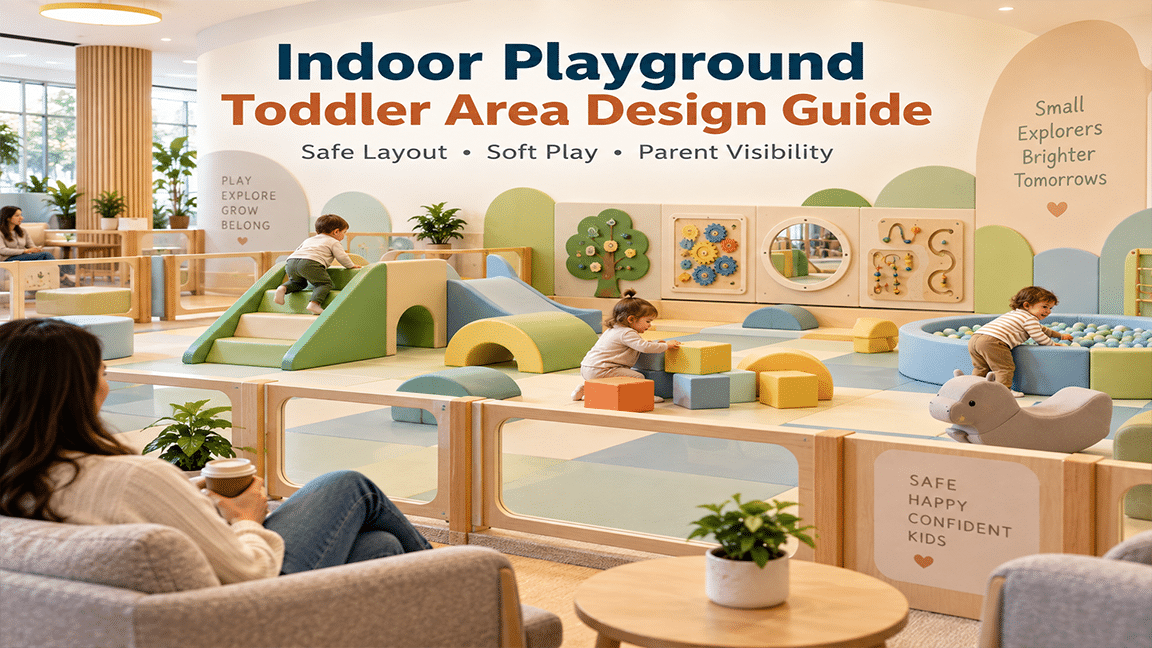
The toddler play area is primarily designed for children aged 1–4. Equipment features lower heights and softer structures, with a focus on sensory development and the cultivation of basic motor skills. This is a must-have zone for any venue targeting young families.
Key Features:
Applicable Scenarios:
Adventure play areas are designed for older children (6–12), incorporating more challenging and physically engaging elements. These structures are the centrepiece attraction of most large independent FECs and park venues, and consistently generate strong repeat visit rates.
Key Features:
Applicable Scenarios:
Bouncy castle areas mainly attract children aged 6 to 12 and have the highest rate of repeat visitors of all types of playground equipment. These facilities require a clear height of 16 to 20 feet and have higher safety requirements but generate extremely high earnings per square foot.
Key Features:
Applicable Scenarios:
To achieve the highest investment return and reduce operational risks to a minimal extent, B2B investors should evaluate the following key factors before placing an order:
The size of the venue is a key factor in defining the scale, size and design of the indoor play area. Before contacting any suppliers, please confirm the venue’s exact dimensions.
Safety is the most critical factor when selecting professional playground equipment. Never skip this step – equipment not meeting standards can lead to legal and insurance issues.
Children of different age groups exhibit distinct physical requirements and risk tolerance. Designing for the correct age mix will determine your layouts, zone requirements and business model.
Toddlers (1–4 years): Soft play equipment, interactive sensory features, low-level equipment
Children aged 4–10: slides, climbing structures, obstacle courses
Teenagers (aged 10 and above): adventure courses, trampolines, ninja courses
A unique thematic design makes an indoor play area more visually appealing, memorable and shareable on social media – factors that attract new customers without the need for additional advertising expenditure.
Custom themes can help create a distinctive brand identity for your play space.
The cost of an indoor play center depends on its size, the number of play structures, and the level of customization. Please view this as a long-term capital investment rather than a one-off purchase.
Selecting an experienced indoor children’s playground manufacturer is crucial. The wrong supplier creates delays, quality failures, and costly post-installation repairs.

Before purchasing commercial play structures, consider the following recommendations to avoid the most common and costly mistakes:
Before confirming your order, please ensure that every item on this checklist has been met:
✔ Identify the target user group: Young children (1–4 years), children (4–12 years), or a mixed-age group?
✔ Measure the available space: Confirm floor area, height, and the layout.
✔ Determine the type of play zone: Soft play, adventure play, bounce area, or a combined structure?
✔ Verify safety standards: Ensure you have received ASTM, EN 1176 or TÜV test reports from the supplier.
✔ Compare different suppliers: Secure at least three direct-from-factory quotations before confirming a partnership.
✔ Review design and installation plans: Confirm customized 3D layout diagrams and installation schedules.
Selecting a manufacturer with full-chain capability — design, production, and installation — is the single most important procurement decision you will make. The right partner reduces risk, protects your budget, and keeps your project on schedule.
Q1: What is the minimum floor space required to set up a play center?
There is no absolute minimum. A compact soft play zone of 50–100 sq. meters suits mall kiosks, while spaces over 500 sq. meters are ideal for full-scale independent family entertainment centres (FECs).
Q2: Is the equipment difficult to maintain?
No. Most commercial play structures use modular designs. Daily cleaning and weekly tightening checks are all that is typically required for routine upkeep.
Q3: Do you offer global delivery and installation?
Yes. NanPlay’s professional team holds international installation qualifications and provides on-site installation and after-sales guidance to B2B clients worldwide.
Q4: How can I obtain a cost estimate?
Provide a floor plan of your venue and your budget range. Our design team will prepare a draft layout and quotation within 72 hours, at no cost to you.
Q5: What ROI can I expect from an indoor play centre business?
Well-located venues generate $150,000–$400,000 annually through admissions, party packages, and memberships. Most operators break even within 18–36 months. Direct factory sourcing can accelerate this by 6–12 months.
Start Your Indoor Playground Equipment Project Today
The indoor play centre business offers strong financial returns and long-term social value. Investing in the right indoor playground equipment — and partnering with a certified, full-service manufacturer — ensures a profitable launch, whether your venue is a mall family zone, a park attraction, or a standalone play centre.
Ready to move forward?
Thank you very much for your inquiry! Your trust is our greatest motivation. We are committed to offering playgrounds that combine high quality with affordable pricing. Let us bring vitality to your venue!