18 8 月 2026
18 8 月 2026
18 8 月 2026

18 8 月 2026
18 8 月 2026
You are considering opening an indoor playground in 2026. This direction is the right direction. In 2025, the global market size of indoor entertainment centres will be 54.73 billion US dollars, which is expected to rise to 121.54 billion US dollars by 2033. More and more families are willing to spend money on experiences rather than on physical goods. Indoor games. The music hall is just in the middle of this trend.
However, buying commercial indoor playground equipment is not the same thing as buying a toy for your own backyard. What you are doing is a serious commercial investment. If you choose the wrong one, the maintenance cost is high, the customer is not satisfied, and if it is serious, you may be asked to stop business because of safety issues. This guide will go through all the key links, from choosing the right equipment to choosing the supplier of the spectrum.
This guide walks you through everything you need to know—from choosing the right equipment to picking a supplier you can trust. Companies like NanPlay, a turnkey manufacturer with over 15 years of experience and 1,000+ global projects, are exactly the kind of partners you should be looking for.

The indoor playground has developed rapidly in recent years. The family entertainment centre (FEC) is no longer the same as before, with only slides and ball pools. By 2026, FEC, which has done a good job, will move in the direction of “sports and entertainment” in the industry, that is, the kind of immersive experience with a little competitive flavour. Each year, it is not only for children, but more and more hybrid FECs are bringing a variety of rides together to maximize their indoor play equipment ROI.
What does this mean to you? When choosing equipment, you should consider that it can attract a wider range of people. If you only focus on children, you may miss some of the opportunities to make money. Teenagers and adults are actually willing to play, and they are not ambiguous about spending money.

You may think that buying cheaper equipment can save some money, but really, don’t do this. Household-grade things can’t bear so many children to toss and turn around in commercial playgrounds every day. Commercial-grade materials use heavy steel frames, flame-retardant soft foam, and industrial-grade fasteners, which are originally designed to receive thousands of guests every month. They meet international safety standards, and there will be no big problems after ten years of use. The return on investment is commendable. Cheap materials are a little saved in the front, but later maintenance costs money, reputation will be damaged, and the safety inspection may not be passed, so it is more expensive.

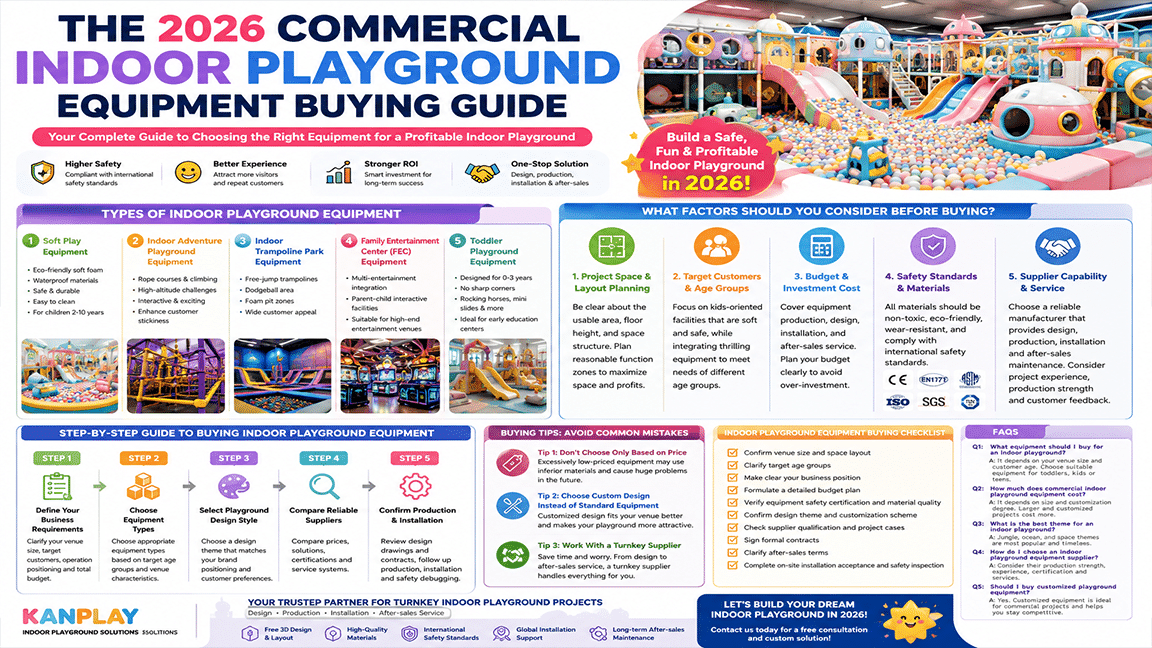
Before looking at the equipment, you must first figure out who your customers are. Are they children from one to four years old who can just leave, school-age children from five to twelve years old, or teenagers and adults? People of different ages have different needs and different safety requirements.
After clarifying the target customer group, you can start to delimit the area. A reasonably designed playground will generally have these parts, such as a low soft package structure for children to play, multi-storey rides for big children, a party room for birthday parties, a rest area where parents can sit and watch their children, and a small bar selling food and drink, no If you want to stuff the equipment into a space indiscriminately, you can expect it to work. You should plan how the family will go and how to move the line in the venue. If the line is smooth, customers will be more willing to spend money.
The things in the commercial playground are tossed by children every day, climbing, jumping, sliding, and pulling everything up. The materials must be able to withstand day after day.
High-density flame-retardant foam should be used in place of the soft package. If the safety inspection can be passed, it will be more durable. The outer PVC coating layer should be thick, tear-resistant, and easy to clean. The steel frame should be heavy, strong, and rust-proof. Industrial-grade screws and connectors must be firm enough. These are not negotiable.
Ask the supplier for their material specification list, and a good manufacturer will give you a detailed list. If you can’t even tell the basic question of what material to use for the equipment, it’s a signal that you have to be careful.
This piece can’t be ambiguous. Your equipment must meet international ASTM EN safety standards without exception.
The U.S. market should comply with ASTM F1487, and the height of the slide and the strength of the swing are all up. The ASTM F1487-26, released in 2026, has new requirements for dynamic equipment such as rotating climbing frames, ground materials, and anti-winding. The European market should meet EN1176, which is a permanent safety standard. The safety requirements of the public amusement equipment are the same for the two standards: anti-fall, stable structure, and preventing children from getting stuck.
What you need to do is ask the supplier for the actual certification documents. Don’t just listen to them; verify whether it is the latest version (ASTM F1487-26 is the 2026 version), get the test report issued by the independent laboratory, and then confirm that the material is non-toxic and lead-free. Manufacturers who can’t come up with compliance and safety documents don’t need to. It’s a waste of time
How you arrange your space not only affects the customer experience but also how much you can earn. If it is too crowded, it is uncomfortable and unsafe. If the layout is not arranged, it is easy to be blocked, and parents are also annoyed.
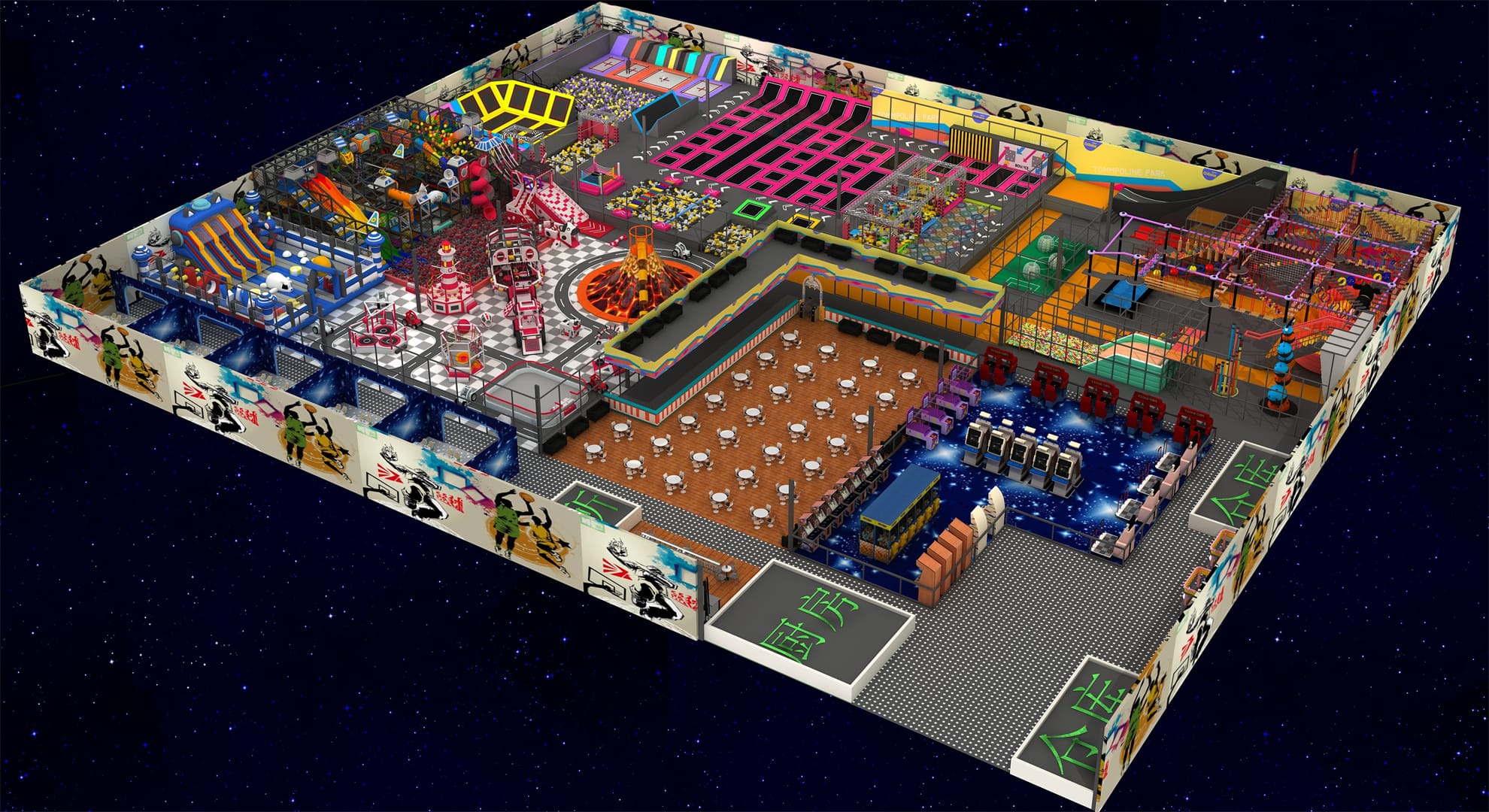
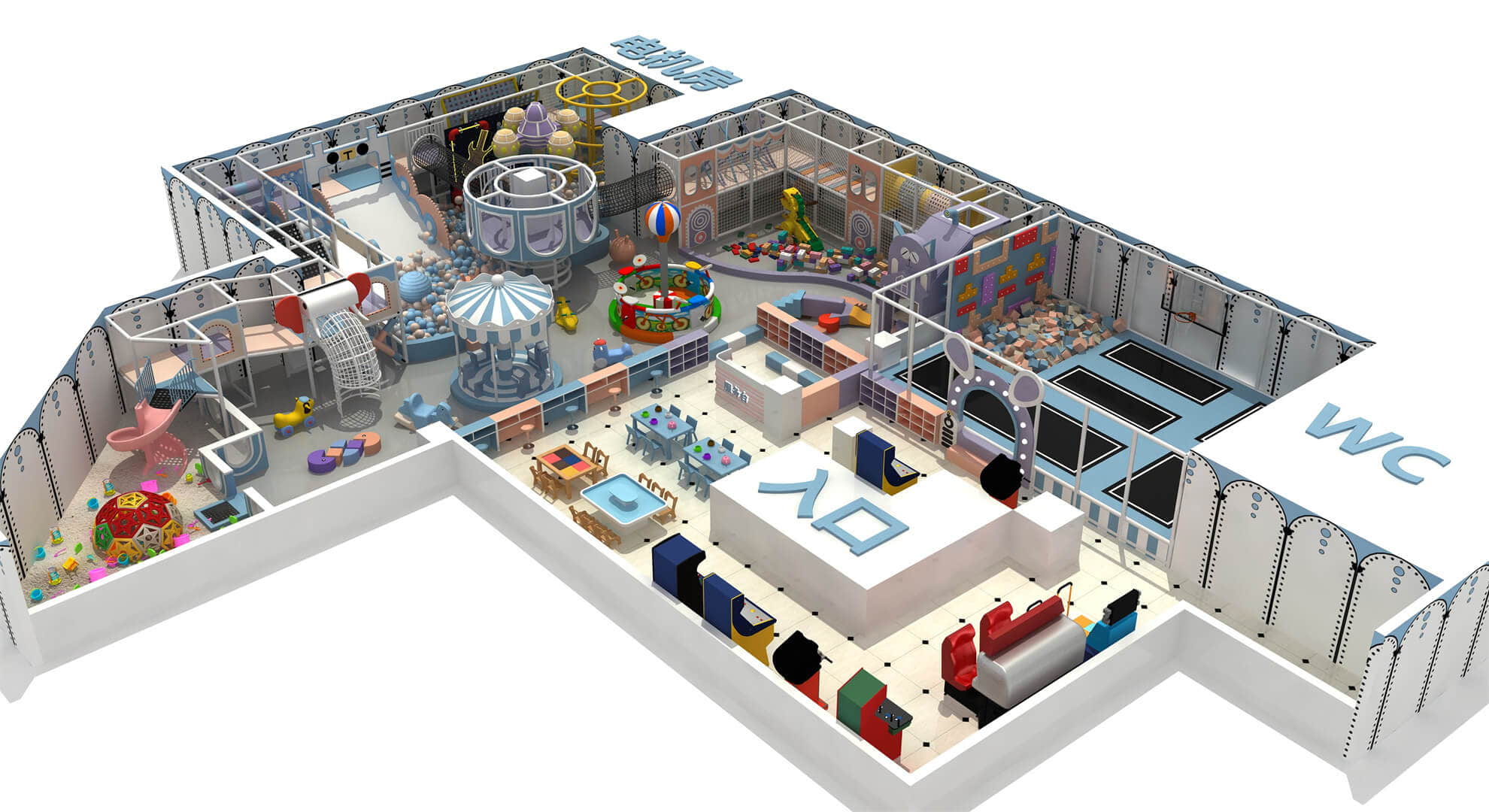
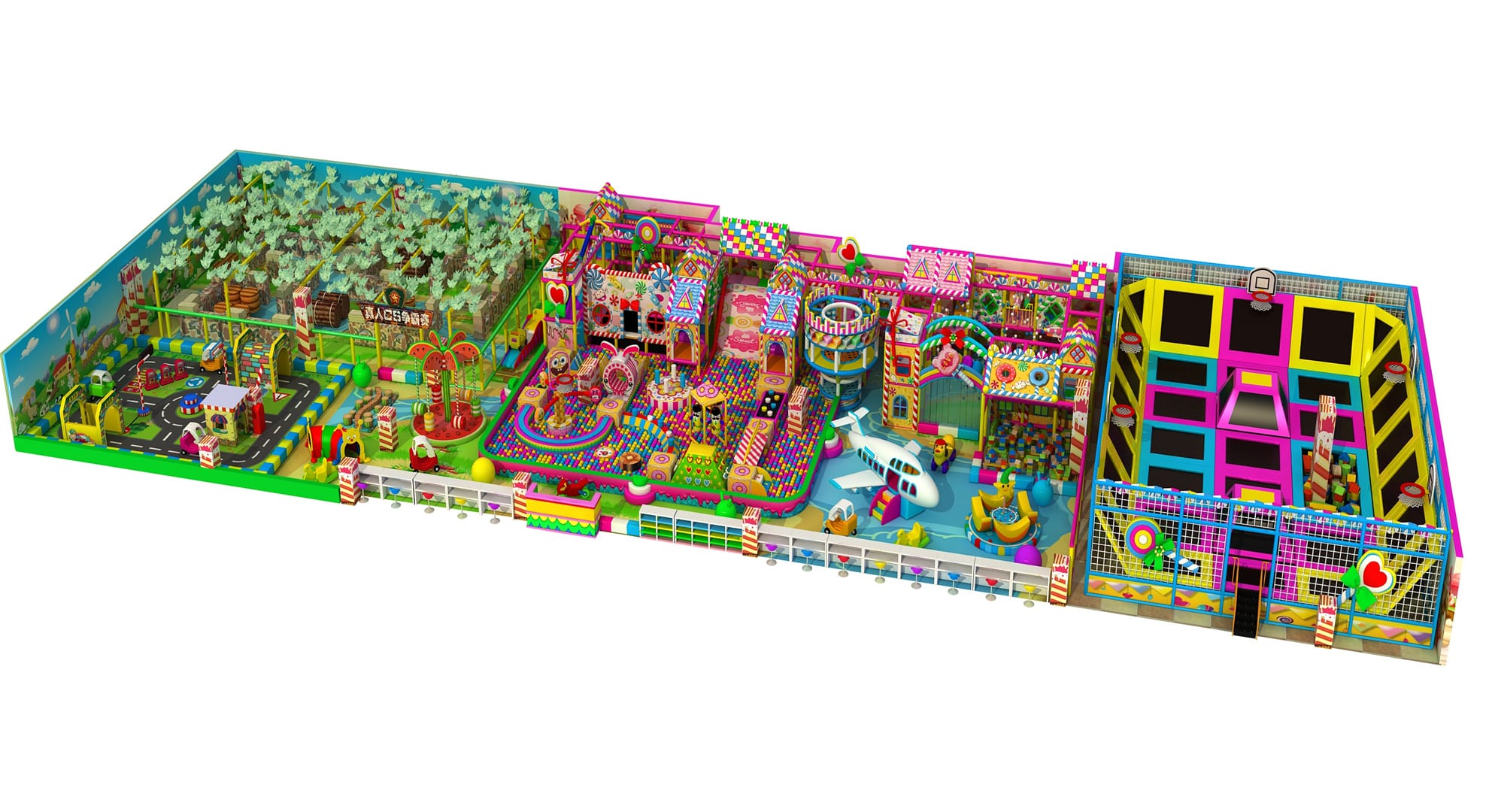
Before buying equipment, cooperate with the supplier to make 2D layout drawings and 3D renderings. A good design should balance the amusement area, passage, seating area, and vision. Parents should be able to see their children at any time. This is a basic safety requirement and the expectation of customers.
The capacity should also be considered. How many children can be put in this space at a time? If it is too crowded, there will be safety problems. If there is too much space, it will waste the opportunity to make money. Good suppliers will help you find that balance.
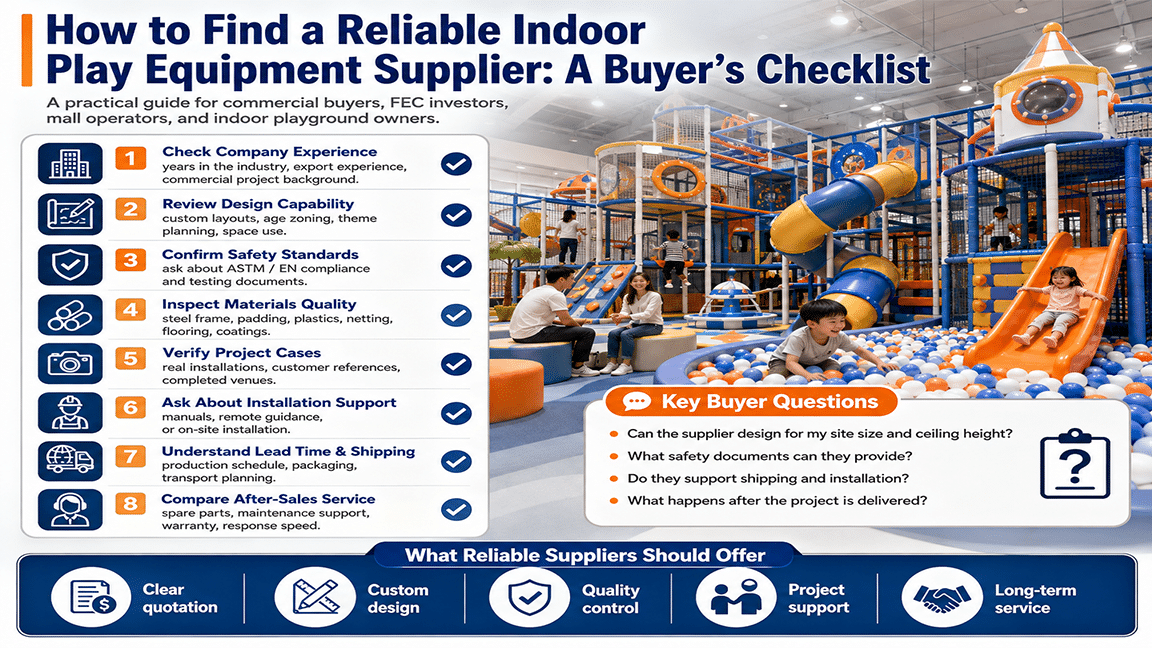
The reality is that you buy not only equipment, but also a complete plan. The manufacturer that can cover from beginning to end is responsible for design, manufacturing, transportation, installation, and after-sales service.
Why is this so important? Because it’s too much to coordinate with several suppliers. One is designing, the other is making equipment, and the third is transporting goods. The installation has to be done by yourself. Things are easy to lose, the construction period is delayed again and again, and the cost is getting higher and higher.
One-stop suppliers give you a dedicated person from the beginning to the end. They have done this work, know where the pit is, and can help you save a lot of money. For most bosses who do this for the first time, it is worth spending more money in one stop.

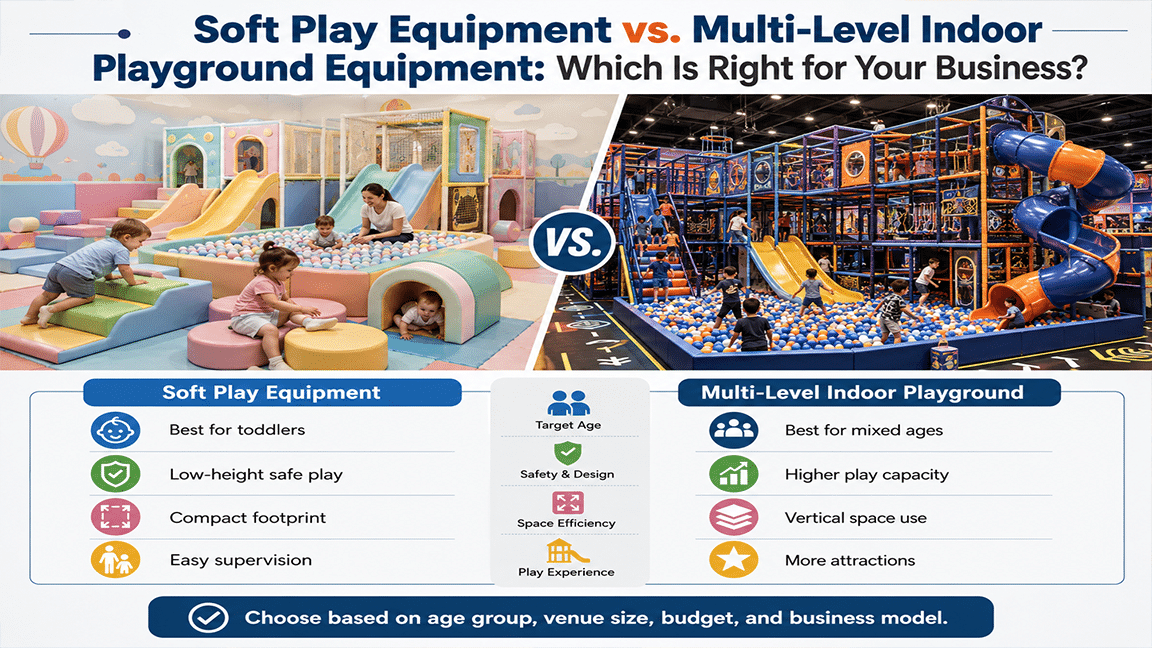
This multi-layer structure is the core of most indoor playgrounds. Climbing, sliding, drilling, and interactive projects are convenient in a small space, saving space and allowing children to play for a long time. Generally, they bring ocean ball pools, wave slides, drilling tunnels, and some obstacle elements.
The trampoline is quite profitable. It can attract big children and adults to play. The audience is suddenly wide, but the ceiling needs to be relatively high, about 16 to 20 feet, and the safety standards are also stricter. However, the trampoline has the most repeat customers among all amusement equipment. If the venue is high enough, it is worth considering.
If you want to attract families with babies and children who have just started to walk, there must be a special sensory area, which is low in height and softer. Some interactive panels can help children develop sensory and motor skills, which is basically the standard for young families.
This is the direction of 2026. Projection games, AR/VR experiences, and motion tracking floors are slowly becoming standard in modern FECs, which can attract children who like technology. Parents are also willing to take pictures and post them on social media. It is more expensive in the early stage, but because it can cover a wider age group, the return on capital is usually faster.

The supplier should be able to do professional 3D CAD design for you, so that you can clearly see what the playground looks like after it is built. A good design service generally includes 2D layout drawings, 3D renderings, and theme customisation. If you can’t even get a detailed spatial model, let’s see. Look at another house.
Does the supplier produce by himself or take the goods from other places? The manufacturers who produce themselves usually have more advantages in price and better quality control. You can ask how big their factory is, what the production process is, and whether it has its own quality control system. The factory area is more than 50,000 square metres, and there is an internal research and development and production team, which is a better signal. Manufacturers outsourced to others are not so stable in terms of quality and delivery time.
Installation work can’t be done by finding a local repairman. The professional installation team knows how to assemble the equipment safely and efficiently and also understands the local building specifications and safety requirements. Ask the supplier if they provide installation services, or if they can recommend a certified installer on your side.
After the equipment is installed, a good supplier will give you a reliable warranty (at least one to three years). If it is broken, you can also get it if you need to replace the parts. Ask clearly whether they respond quickly to the repair request, whether there are Chinese-speaking service personnel, and whether the commonly used replacement parts are in stock. When the equipment really has a problem, these details are very important.

The cost of commercial indoor playground equipment in 2026 mainly depends on the size of the space and the project you choose.
| Project Size | Area | Equipment Cost |
| Small | Under 500 sq ft | $10,000 – $30,000 |
| Medium | 500 – 1,500 sq ft | $30,000 – $80,000 |
| Large | Over 1,500 sq ft | $80,000 – $200,000+ |
The cost of equipment is only a part. The freight of transporting a large container from overseas is about 3,000 to 10,000 US dollars, and the import customs duty is about 5% to 25% of the equipment price. The installation fee is generally 5,000 to 20,000 US dollars or even higher. Before signing the contract, all of these must be included in the budget.
A well-designed playground is not only beautiful but also profitable. Customised themes and special projects can allow customers to take photos and post them on social media, which is equivalent to advertising for you for free. Unlike others, you can charge higher tickets and attract more birthday parties, ensuring a higher indoor play equipment ROI that can often be earned back within the first year of opening.

The cheapest equipment is rarely the best deal. Low prices usually mean low-quality materials, poor safety, or no after-sales support. You will spend more on repairs, maintenance, and potential lawsuits later. Add up the total cost of ownership over 5 to 10 years—including maintenance, replacement parts, and downtime—and you will see that cheap equipment costs more in the long run.
Some buyers try to save money by buying equipment from one supplier, flooring from another, and installation from a third. This almost always leads to problems. Responsibility gets shifted around. If something goes wrong, each vendor blames the others. A one-stop turnkey supplier takes full responsibility for the entire project. This saves you headaches and protects your investment.
This is one of the most common mistakes. You find a space that seems big enough, buy equipment to fill it, and then realize you have no room for walkways, seating, or emergency exits. Or you pack too many attractions into a small space and create safety hazards. Get professional help with space planning. A good supplier will do a site survey and help you plan a layout that balances play areas with safety and comfort.

Commercial indoor playground equipment costs between $10,000 and $200,000+, depending on size and quality. Small playgrounds (under 500 sq ft) cost $10,000–$30,000. Medium playgrounds (500–1,500 sq ft) cost $30,000–$80,000. Large playgrounds (over 1,500 sq ft) exceed $200,000. Remember to add 30–50% for hidden costs like installation, flooring, and shipping.
For the US market, ASTM F1487 is the main standard. The 2026 version (ASTM F1487-26) introduced new requirements for dynamic equipment and fall zones. For Europe, EN1176 is the required standard. Both cover structural integrity, fall protection, and entrapment hazards.
The full process typically takes 2 to 6 months. Manufacturing takes 4–8 weeks. Shipping takes 2–6 weeks. Installation takes 1–4 weeks. Turnkey suppliers are usually faster because they coordinate everything.
A turnkey supplier handles everything—design, manufacturing, shipping, installation, and after-sales support. This gives you one point of contact, reduces coordination headaches, and minimizes costly mistakes. For most first-time owners, the extra cost is worth the peace of mind.
Space requirements vary by your target audience and equipment mix. A small playground for toddlers might need only 500 sq ft. A full-scale FEC with multiple attractions could need 10,000 sq ft or more. Most suppliers offer free site evaluation to help you determine the right size for your space.
With proper maintenance, commercial-grade equipment lasts 5 to 10 years or more. High-quality materials like heavy-duty steel frames and flame-retardant foam hold up well. The key is regular inspections and timely replacement of worn parts. A good supplier provides maintenance guidelines and spare parts.
Choosing commercial indoor playground equipment in 2026 is about more than picking a few slides and ball pits. Start by defining your target audience and planning functional zones. Verify that every piece of equipment meets ASTM F1487 or EN1176 safety standards. Prioritize commercial-grade materials that stand up to daily use. Work with a turnkey supplier who can handle design, manufacturing, and installation from start to finish.
Remember the three costly pitfalls: don’t chase the lowest price, don’t use fragmented vendors, and don’t underestimate your space requirements. A smart buying strategy saves you money, protects your customers, and builds a strong foundation for your business.
The best way to start is by talking to a supplier who can show you what your playground will look like. A custom 3D design plan helps you visualize the space, spot potential issues, and make informed decisions before you spend any money. Most reputable turnkey suppliers offer this service as part of their initial consultation—if you are looking for a turnkey playground manufacturer, NanPlay is a solid choice. Do not buy anything until you have seen it in 3D. That is how you avoid costly mistakes and build a playground that families will love.
Thank you very much for your inquiry! Your trust is our greatest motivation. We are committed to offering playgrounds that combine high quality with affordable pricing. Let us bring vitality to your venue!