21 September 2026
15 September 2026
14 September 2026

14 September 2026
14 September 2026
Indoor playground location is one of the most critical factors determining the success and profitability of an indoor playground business.It is critical to long-term success. The right location directly determines foot traffic, revenue, and profitability. Priority should be given to densely populated areas, high-traffic shopping malls, and strong commercial complexes. Key factors include target customer demographics, spending power, competition level, transportation accessibility, and parking convenience.Operators must also evaluate rental costs, visibility, and nearby entertainment facilities. In addition, technical requirements such as floor area, ceiling height, structural capacity, and safety compliance are essential to ensure proper equipment installation and safe operation.

First, you should choose locations with high foot traffic, such as densely populated areas, neighborhood commercial centers, and upscale shopping malls; this will drive growth in consumer spending and foot traffic, thereby increasing the rate of in-store visits.
Target densely populated areas, particularly neighborhoods or commercial districts with children aged 3–12, to boost conversion rates.
Is the indoor playground easily accessible? Are there plenty of transportation options? Is there ample parking? These factors help increase foot traffic.
When selecting a location for an indoor playground, the first consideration should be whether there are already similar indoor playgrounds in the vicinity, in order to avoid excessive competition and identify opportunities for differentiation.
Consider whether the surrounding area includes movie theaters, indoor amusement parks, and restaurants, as these venues can increase foot traffic and boost spending. They generate revenue for nearby businesses, extend the time families spend in the mall, and increase visitation rates at indoor amusement parks.
Analyze whether there are already similar indoor amusement parks or well-known brands in the surrounding area to determine if the market is overly competitive, thereby avoiding a situation where homogeneous indoor amusement parks draw away customers and reduce revenue.
By analyzing population size, household income levels, and consumer habits, we can assess the actual demand for indoor play centers to ensure the project proceeds smoothly and thereby increase revenue.
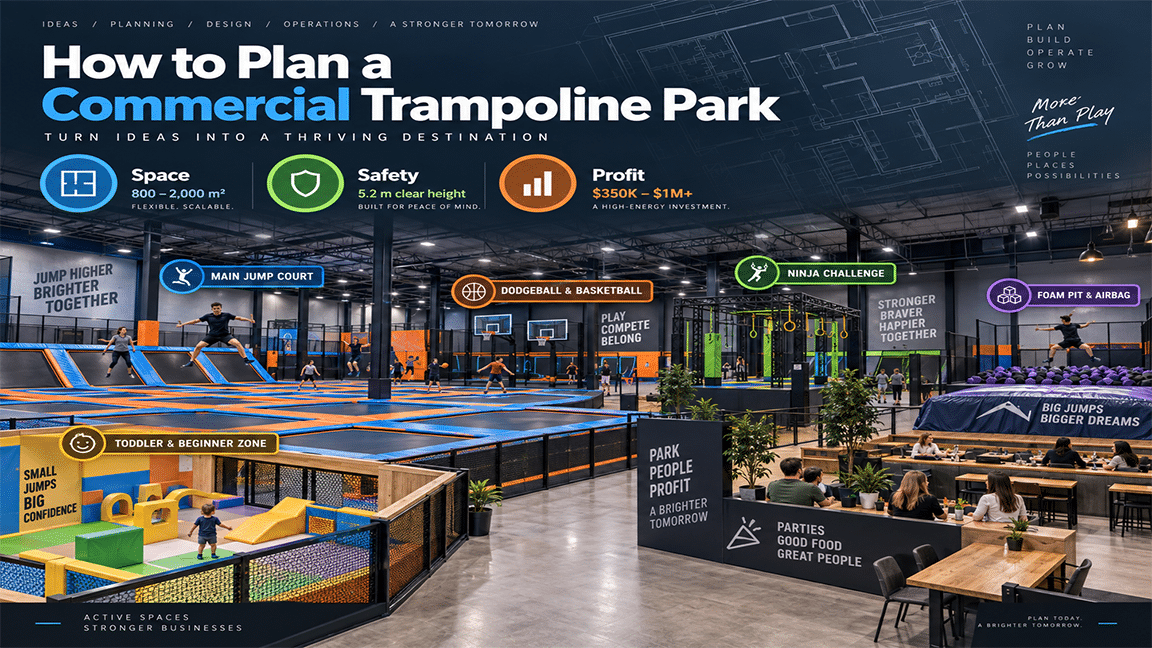
Indoor play centers typically cover an area of at least 300 square meters, with medium- to large-scale facilities ranging from 500 to 3,000 square meters or more. This ensures there is ample space to offer a wider variety of activities, thereby increasing foot traffic and revenue.
Indoor amusement parks must have a clear ceiling height of at least 4.5 meters. Large play structures, rope adventure courses, slides, and similar attractions typically require a ceiling height of 6–10 meters or more to accommodate equipment installation and ensure safe operation.
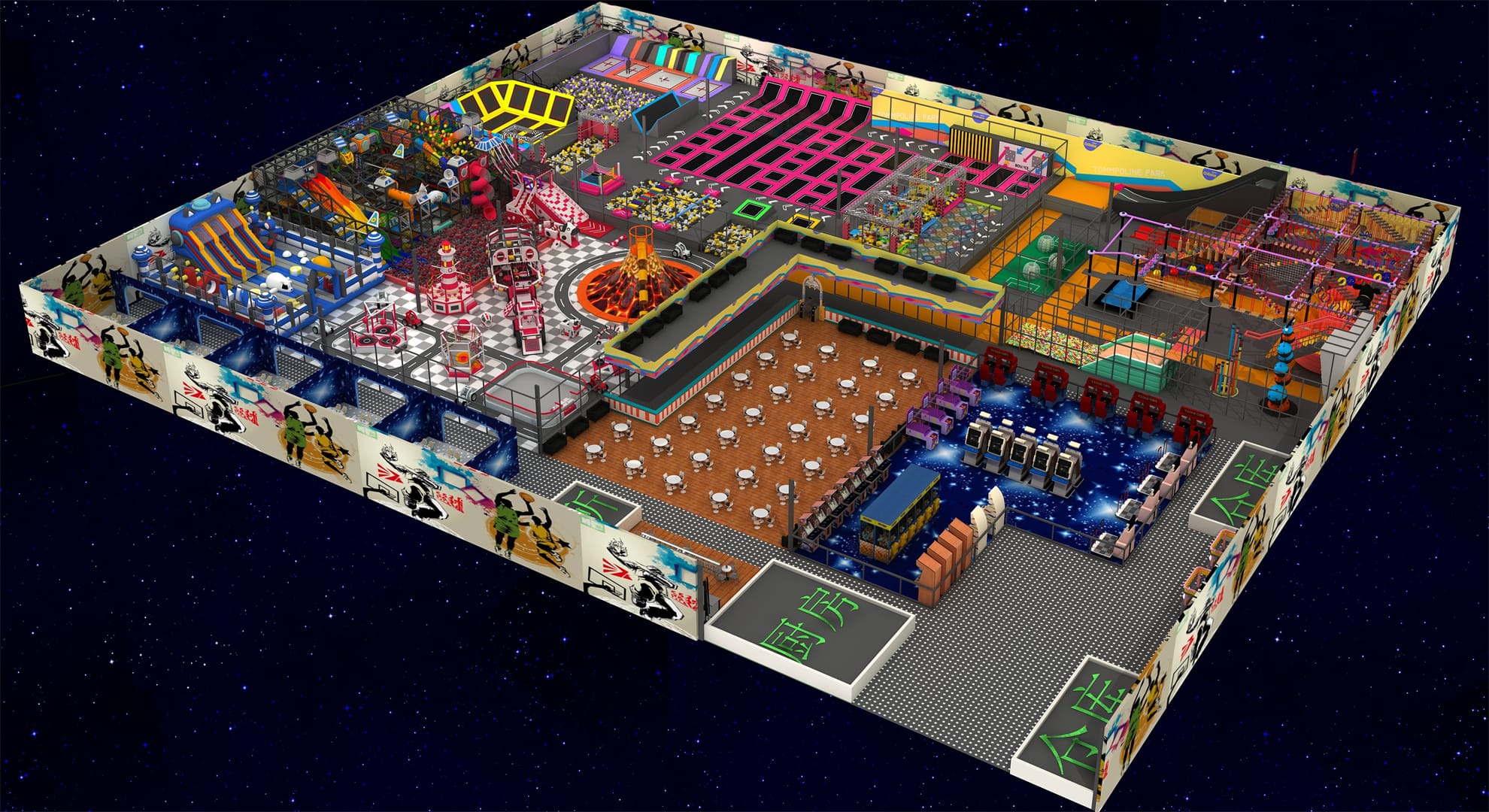
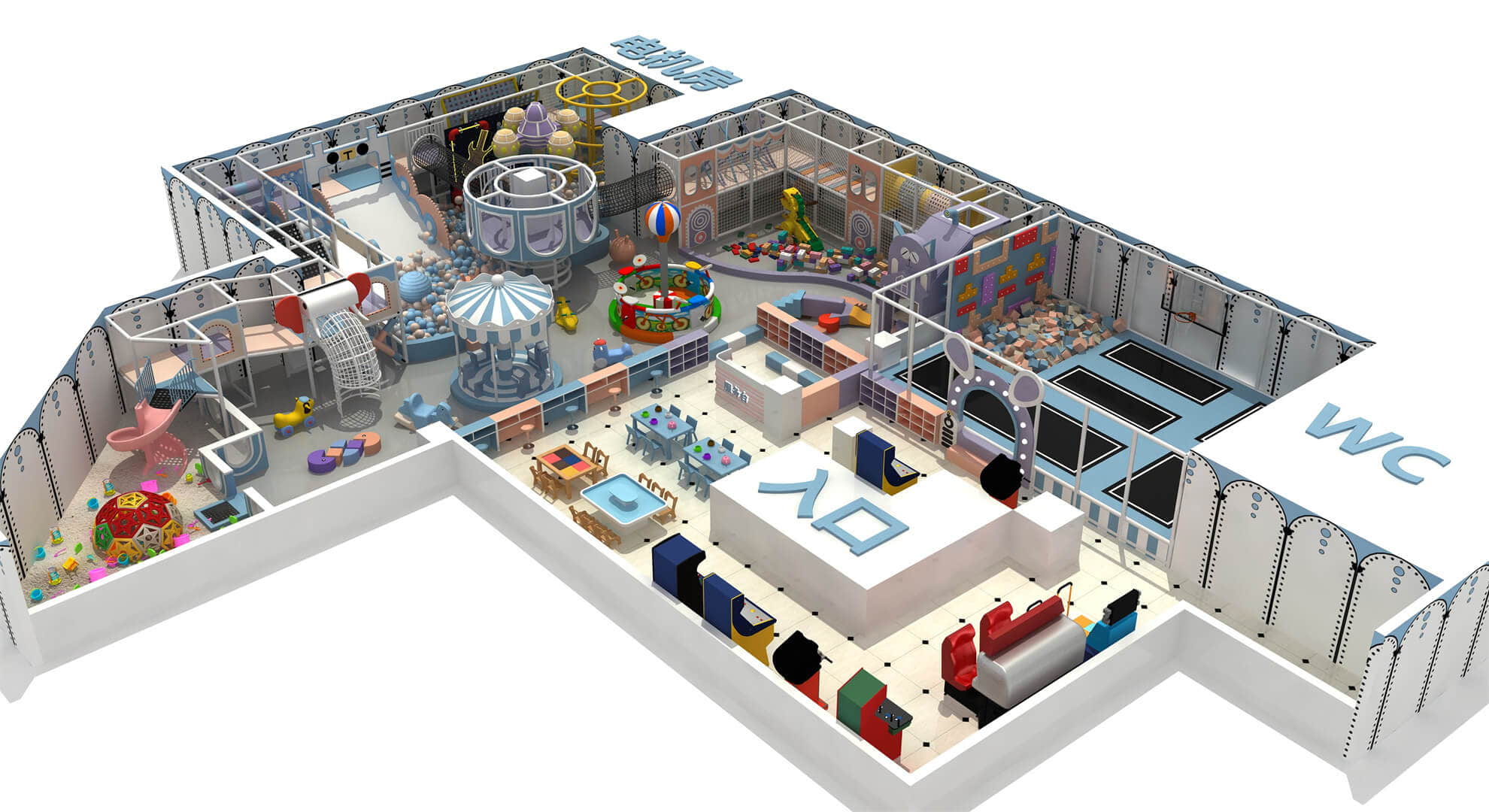
When selecting a location for an indoor playground, choose an area with ample space. During the initial planning phase, it is essential to carefully plan how the space will be utilized. Functional zones should be arranged logically to facilitate the future installation of new equipment.
Keep the column spacing at 6 meters or more. The fewer the columns, the better it is for the safety of the target audience, the planning of equipment installation, and the design of visitor flow paths; this also minimizes wasted space. This approach reduces the risk of injury among the target audience and ensures safety.
The floor load-bearing capacity must comply with local building codes; it is generally recommended to be 300–500 kg/m² or higher to accommodate large amusement rides, pedestrian traffic, and long-term operational requirements.
Plan the use of space efficiently, designating areas for parties, dining, rest, and play; make effective use of the space to achieve an effective space utilization rate of 70%–85%, thereby enhancing the value and return on investment of the indoor amusement park.

Advantages and Disadvantages Comparison
| Venue Type | Advantages | Disadvantages |
| Shopping Malls & Commercial Centers | High foot traffic, strong brand exposure, family-oriented customer base, easier customer acquisition | Higher rent and operating costs, stronger competition |
| Standalone Buildings | Flexible site selection, full control over branding and operating hours, greater expansion potential | Requires independent marketing and customer attraction efforts |
| Community & Residential Areas | Strong customer loyalty, higher repeat visits, lower rental costs | Limited customer volume, highly dependent on local population density |
| Mixed-Use Commercial Developments | Steady foot traffic, synergy with retail and dining businesses, diversified customer sources | More complex leasing terms, must align with overall commercial positioning |
Shopping malls and mixed-use complexes: High return on investment, suitable for large indoor playgrounds and family entertainment centers (FECs).
Stand-alone buildings: Significant potential for return on investment growth, contingent on the brand’s operational capabilities and marketing prowess.
Community projects: Relatively stable return on investment, better suited for small- to medium-sized children’s play areas and indoor playgrounds operating on a membership-based model.
Ensure that the target audience aligns with the project’s positioning.
Comprehensively assess the proportion of rent relative to operating revenue.
Pay attention to parking availability, transportation accessibility, and the site’s visibility.
During the initial phase, consider the potential for future expansion and equipment upgrades.
Analyze the competitive landscape and long-term growth potential of similar products.
During the initial launch phase, the first step is to assess rental costs against projected revenue streams. This includes setting ticket prices, determining membership card terms, and evaluating revenue from venue rentals, birthday parties, food and beverage sales, and merchandise. Prime locations in the surrounding commercial district command higher rents, resulting in greater market value and higher revenue. Conversely, less desirable locations have lower rents, lower market investment value, and lower revenue.
The higher the initial investment, the greater the long-term returns. Initial investments primarily include expenses related to the purchase of amusement equipment, venue renovation, flooring, lighting systems, safety facilities, licensing, branding, staff training, and grand opening promotions. All of these expenses require capital investment; the larger the project and the more complex the design, the higher the startup costs.
Return on Investment (ROI) is calculated based on revenue, operating costs, and net profit. For indoor playground projects with strong operating revenue, the payback period is approximately 2 to 5 years.
Before signing the lease, you should carefully review key provisions such as the lease term, rent escalation mechanisms, renewal rights, property maintenance responsibilities, business type protection clauses, and early termination conditions. Reasonable lease terms help mitigate operational risks and enhance long-term returns.
You need to factor in expenses such as utilities, employee salaries, insurance premiums, equipment maintenance, cleaning services, software systems, marketing, and government compliance requirements. These hidden costs can directly impact the project’s actual profitability.
When calculating the break-even point, it is necessary to assess monthly visitor turnout, ticket sales, and membership sign-ups and renewals to ensure that monthly revenue and expenses reach the break-even point. An accurate break-even analysis can significantly reduce investment risks and facilitate subsequent operational planning and decision-making.
“Structural load-bearing capacity: unit load ≥ 300–500 kg/m².” Factors such as equipment weight, pedestrian traffic density, and dynamic impact forces must be taken into account. Insufficient load-bearing capacity will result in high structural reinforcement costs and may prevent the installation of equipment.
Prior to the start-up phase, the facility must pass a local fire safety inspection, which covers sprinkler systems, smoke detectors, fire compartments, and fire-retardant materials. Failure to meet these standards may result in the inability to open for business or require repeated corrective actions, thereby impacting the project schedule and costs.
The air circulation system operates safely and reliably, preventing the space from becoming stuffy. Emergency exits must meet evacuation distance standards, and pathways must be clear and unobstructed to ensure rapid evacuation in the event of an emergency.
The electrical system requires a dedicated power distribution system or high-load circuits to support the simultaneous operation of lighting, equipment, audio systems, and interactive systems. Voltage fluctuations can cause equipment malfunctions and even pose safety hazards.
The ground must be covered with EPDM or PVC flooring to prevent any damage that could compromise the stability of the equipment or the safety of the children.
Soft padding must be installed throughout the entire area, including columns, corners, and equipment connection points. The protective covering must be impact-resistant, fire-resistant, and wear-resistant. This will reduce the likelihood of accidents and ensure the safety of children.
When selecting a store location, priority should be given to spots near the main entrance, atrium, main aisles, or elevator lobbies. A hard-to-find location will reduce foot traffic, and even high foot traffic won’t be enough to compensate for this.
Visitor traffic is concentrated mainly on weekends, holidays, and during winter and summer breaks; on weekdays, it consists primarily of occasional visitors.
Families tend to travel on weekends, holidays, and during winter and summer breaks. Most families check whether there is an indoor amusement park nearby; if there is, they may walk there, but if the area is crowded, they will likely drive. The availability of parking spaces directly affects visitor turnout.
When evaluating the business environment for family-oriented consumption, factors such as the variety of shops in the surrounding area are taken into account; this creates a chain reaction of spending that boosts revenue for local businesses, increases dwell time, and raises the rate of repeat purchases for indoor amusement park tickets.
For indoor playgrounds and trampoline parks, weekend traffic is often the key revenue driver. An ideal location generates 1.5–3 times more visitors on weekends than weekdays, with a high proportion of families and longer dwell times. Strong weekend traffic usually indicates higher spending potential, better membership growth, and stronger event bookings.
Anchor stores such as supermarkets, cinemas, family restaurants, and major retailers significantly boost customer flow. They attract families, increase visit frequency, and encourage cross-shopping. A venue located near a strong anchor tenant benefits from greater visibility, lower customer acquisition costs, and more stable long-term traffic. Strong weekend family traffic combined with powerful anchor stores is a key indicator of a successful entertainment venue.
A poor choice of store location can result in high foot traffic but low revenue, as it overlooks the actual conversion rate.
The design did not take into account the site’s ceiling height or the vertical space requirements of the equipment; as a result, large-scale amusement rides cannot be installed at a later stage, severely limiting the project’s scale.
An incomplete preliminary budget can result in significant costs and manpower being expended during construction, thereby affecting the return on investment.
The entrance layout is unclear, which reduces the rate of customers entering the store and affects foot traffic.
After conducting a comprehensive evaluation of multiple candidate sites, the optimal option was ultimately selected. At the same time, negotiations focused on rent, rent escalation mechanisms, rent-free periods, business type protection, and lease renewal terms to minimize long-term operational risks as much as possible.
Conduct on-site surveys to verify key details firsthand, including actual foot traffic patterns, surrounding retail offerings, parking convenience, entrance visibility, construction conditions, the current state of fire safety facilities, and noise levels, to ensure that the data on paper aligns with the actual situation.
Have a professional design team conduct a spatial planning and equipment layout assessment, including traffic flow design, safety zoning, equipment compatibility, and space efficiency optimization, to ensure maximum utilization of the space and compliance with safety standards.
The system evaluates four categories of risk: market risk (fluctuations in customer traffic and competition), operational risk (management and human resources), financial risk (costs and cash flow), and regulatory risk (fire safety and compliance). This process results in a comprehensive risk rating, which is used to inform investment decisions.
A “quantitative scoring plus comprehensive weighting” approach (typically on a 100-point scale) is used to determine whether a location has investment value. Key factors include traffic, visibility, competition, costs, and profitability ased on actual per-capita spending rather than foot traffic;
Key metrics: Average daily foot traffic, percentage of family customers, weekend peak traffic, and length of stay.
Scoring logic: Stable foot traffic + high percentage of family customers = high score; foot traffic consisting mainly of passersby = low score.
Is the location clearly visible?
Key criteria: Is it near the main entrance? Is it in the atrium or along a main aisle? Is the view unobstructed? Does it have advertising space?
Reasoning: High visibility = high conversion; hidden corners = low rating.
Is There Excessive Competition from Similar Projects?
Key Metrics: Number of similar projects within a 3–5 km radius, scale of competitors, and brand strength.
Rationale:
Low competition: Significant opportunities
Moderate competition: Healthy market
Excessive competition: Severe diversion of customer traffic
Potential Profitability
Key metrics include: rent-to-revenue ratio, estimated average transaction value, average daily foot traffic, and operating costs.
Key points: The higher the ROI, the shorter the payback period (ideally 2–5 years).
Total Score = Σ (Factor Score × Weight)
| Factor | Score | Weight | Weighted Score |
| Traffic Potential | 9 | 25% | 2.25 |
| Family Demographics | 8 | 20% | 1.60 |
| Rental Cost | 7 | 15% | 1.05 |
| Visibility | 8 | 10% | 0.80 |
| Parking Convenience | 9 | 10% | 0.90 |
| Facility Conditions | 8 | 10% | 0.80 |
| Competitive Environment | 7 | 10% | 0.70 |
Final Score = 8.10 / 10 = 81 Points
| Total Score | Recommendation |
| 85–100 | Proceed Immediately (Grade A Site) |
| 75–84 | Strong Candidate (Grade B Site) |
| 65–74 | Evaluate Carefully (Grade C Site) |
| 50–64 | High Risk (Grade D Site) |
| Below 50 | Not Recommended (Grade E Site) |
The best locations for indoor playgrounds are in commercial districts and densely populated areas.
A playground project requires at least 300 square meters; medium to large-scale projects typically range from 500 to 3,000 square meters or more.
Shopping malls are highly suitable locations for indoor play centers.
The ceiling height for an indoor play center should be no less than 4.5 meters. Large play structures, rope adventure courses, slides, and similar attractions typically require a ceiling height of 6–10 meters or more.
First, consider the target audience and their spending power, giving priority to densely populated areas. Second, evaluate the foot traffic and rental costs of shopping malls or commercial complexes. At the same time, assess the competitive landscape and opportunities for differentiation. Pay attention to transportation accessibility and the availability of parking. Finally, take into account the floor area, ceiling height, and structural conditions of the site to ensure compliance with installation and safety standards for amusement equipment, thereby enhancing the operation of the indoor playground.
The most common mistakes in site selection include: focusing solely on total foot traffic while neglecting the demographics of the target household; choosing locations with excessively high rent; underestimating competitive pressure from similar businesses; and overlooking parking and transportation accessibility. Another common mistake is relying solely on current daily foot traffic without analyzing future industry trends and dynamics.

Successful site selection requires consideration of foot traffic, the density of family customers, site conditions, and ROI. Focus on weekend foot traffic, anchor store appeal, reasonable rent, and the feasibility of the space; avoid judging solely by surface-level foot traffic, and establish a systematic evaluation model to ensure long-term profitability.
Thank you very much for your inquiry! Your trust is our greatest motivation. We are committed to offering playgrounds that combine high quality with affordable pricing. Let us bring vitality to your venue!