15 September 2026
14 September 2026

14 September 2026
14 September 2026
1 September 2026

If you are planning a new Family Entertainment Center (FEC), choosing Trampoline Park or Indoor Adventure Park will directly affect your investment size, target customers, space utilization, and long-term profitability.
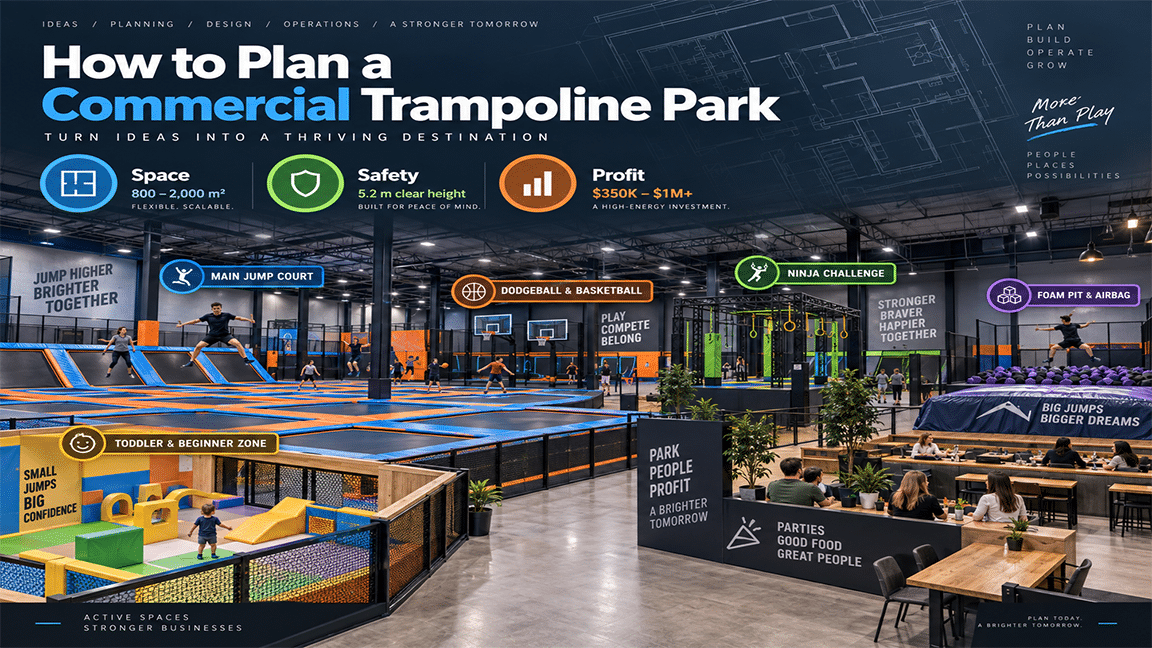
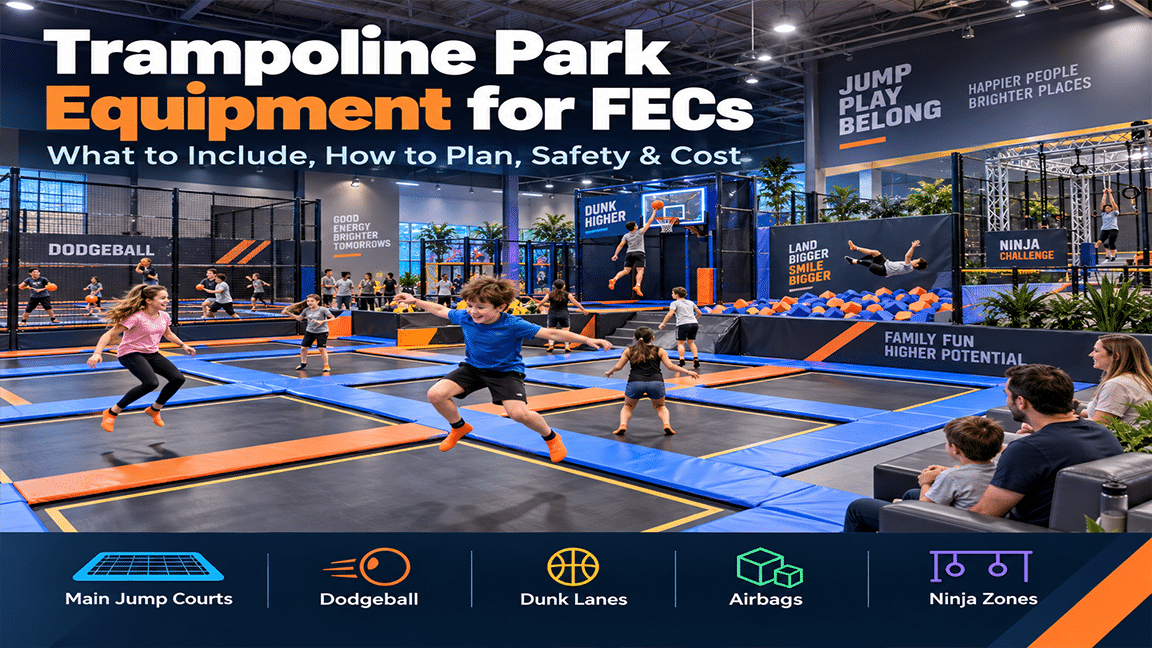
Trampoline Park is mainly built around Commercial Trampoline Park Equipment, such as Free Jump, Dodgeball, Basketball Dunk, Airbag, and Performance Trampoline. In contrast, Indoor Adventure Park usually integrates a variety of projects such as Climbing, Ninja Course, Rope Course, Zip Line, Obstacle Course, and Soft Play.
Therefore, Trampoline Park vs Indoor Adventure Park is not simply comparing which equipment is more popular, but judging which Business Model is more suitable for your site and target market.
No model can guarantee higher ROI in all projects.
If your venue has a high Ceiling Height and the target customers are mainly children, teenagers, and young people, Trampoline Park can quickly form a core attraction by relying on Active Play with high participation.
But if you want to cover more customer groups such as children, teenagers, families, birthday parties, and group bookings, Indoor Adventure Park tends to have a larger project portfolio space.
What investors really need to compare is:
Therefore, the final choice should be based on the complete FEC Feasibility Analysis, rather than simply based on the purchase price of the equipment.
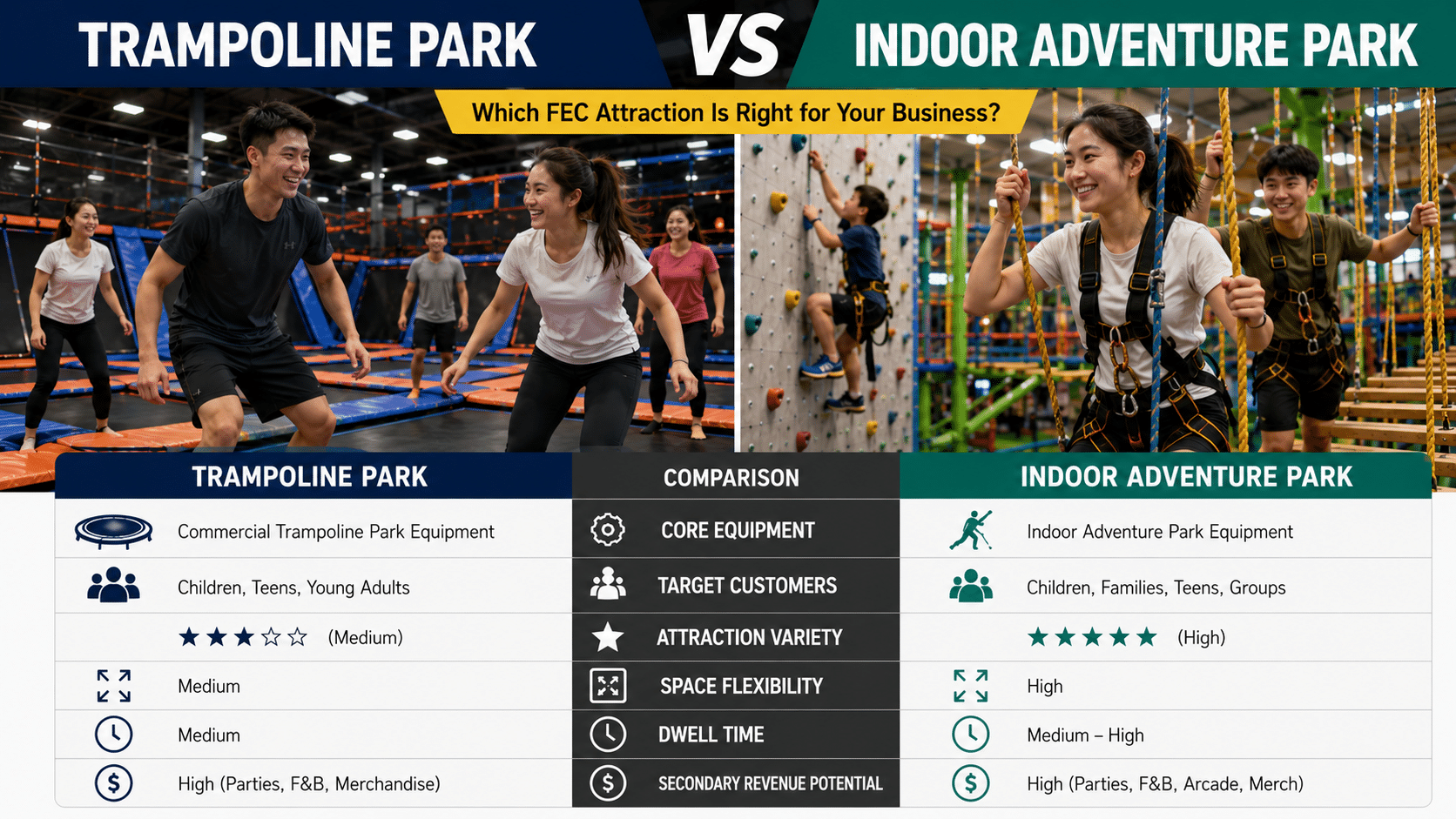
| Factor | Trampoline Park | Indoor Adventure Park |
|---|
| Core Equipment | Commercial Trampoline Park Equipment | Indoor Adventure Park Equipment |
| Main Experience | Jumping & Active Sports | Multi-Activity Adventure |
| Target Customers | Children, Teens, Young Adults | Children, Families, Teens, Groups |
| Attraction Variety | Medium | High |
| Space Flexibility | Medium | High |
| Dwell Time | Medium | Medium–High |
| Birthday Party Potential | High | High |
| Secondary Revenue | High | High |
| Expansion Flexibility | Medium | High |
| Best For | Active Entertainment Venues | Multi-Attraction FEC Projects |
The advantage of Trampoline Park is that the project positioning is very clear. After seeing Trampoline Courts, Dodgeball Zone, or Dunk Area, customers can quickly understand what experience the venue offers. This model is especially suitable for investors who want to establish a distinct Active Entertainment positioning.
Indoor Adventure Park places more emphasis on Attraction Mix. With a reasonable Indoor Adventure Park Design, you can arrange projects of different ages and difficulty levels in the same venue.
For example, after a family of four enters the venue, children can use Soft Play, older children can challenge the Climbing Wall, and teenagers can experience the Ninja Course. This combination can increase the participation of the whole family and reduce the loss of customers caused by age differences.
Therefore, if your core goal is to establish a single but strong entertainment program, Trampoline Park has a clear advantage; if you want to create a comprehensive FEC that covers more consumer groups, Indoor Adventure Park usually has greater flexibility.
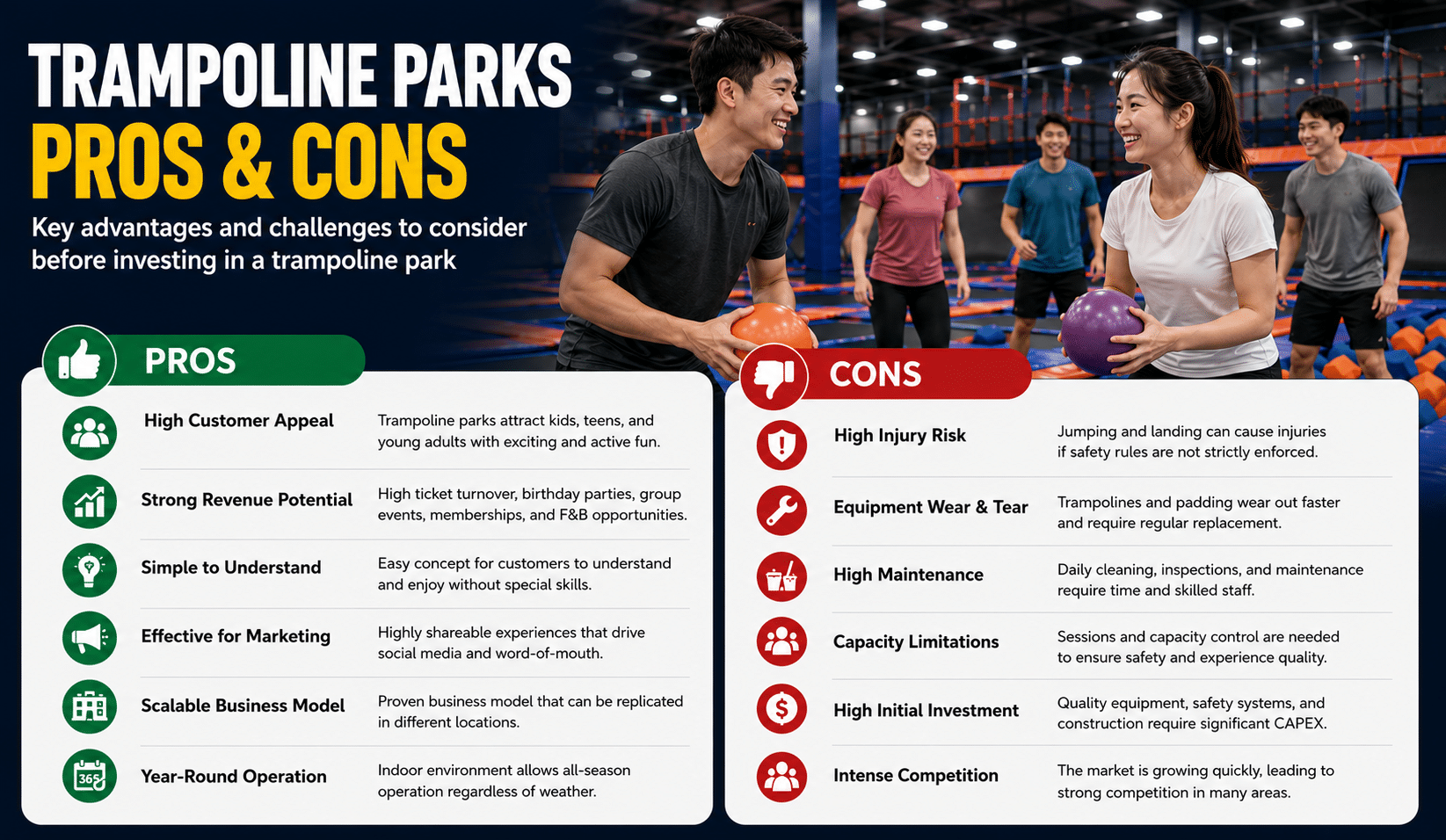
One of the biggest commercial advantages of Trampoline Park is that the project itself has strong visual appeal and participation.
Customers do not simply watch, but directly participate in Jumping, Dodgeball, Basketball Dunk, and other Active Games. This experience is particularly easy to attract children and teenagers, and is also suitable for birthday parties, school groups, and team building.
At the same time, Trampoline Activities are very suitable for producing Social Media Content. Jumping, dunk and challenge activities can form a large number of short video materials to help the venue get Organic Exposure.
If the location, pricing, and marketing strategies are reasonable, Commercial Trampoline Park Equipment can help you build an entertainment brand with a clear market positioning.
High passenger flow does not mean simple operation.
Trampoline parks usually need to pay more attention to:
Because visitors will do a lot of jumping and high-intensity exercise, Springs, Trampoline Beds, Padding and Frame Components need to be checked regularly.
In addition, the Insurance Cost may also be higher in some markets. Therefore, when calculating the return on investment, you can not only look at Ticket Revenue, but also include Insurance, Staffing, Maintenance and Replacement Parts in the long-term Operating Cost.
The conditions of the venue are equally important. Some high-altitude jumps or Adventure Elements have clear requirements for Ceiling Height. If the building itself has a height limit, the combination of optional equipment will be reduced.
It is difficult for the traditional pure Trampoline Court to meet the experience needs of all customers, so more and more venues have begun to adopt the Hybrid Trampoline Concept.
For example, you can add to Trampoline Park:
This way retains the core attraction of Trampoline Park while adding more amusement options.
From a business perspective, the Hybrid Model can also expand the target audience. Customers who don’t like to jump continuously can also participate in other activities, and families with children of different ages are also easier to find suitable projects.
For FECs that plan to operate for a long time, this multi-project portfolio can also improve Repeat Visit Potential, because customers can try different attractions every time they visit.

For many Family Entertainment Center (FEC) investors, the area of the venue is not the only limitation. What is more important is how to improve the commercial value of each square meter of space.
One of the main advantages of Indoor Adventure Park Design is that it can make full use of horizontal and vertical spaces. Unlike large-area trampoline courts, Adventure Park can combine a variety of Indoor Adventure Park Equipment through different heights and levels.
For example:
Climbing Wall and Rope Course can take advantage of the height of the building, and the space below can be planned for other Attractions. For commercial sites with high rent, this Vertical Space Utilization can help you increase the number of entertainment projects in a unit area.
A reasonable layout can also set Difficulty Levels according to different ages, allowing multiple customer groups to use the venue at the same time without the need to establish a completely independent large area for each project.
Another advantage of an Indoor Adventure Park is its wider customer coverage.
The core users of traditional Trampoline Parks are usually concentrated among children, teenagers, and young consumers who like Active Sports, while Adventure Parks can cover more age groups through projects of different difficulties.
For example:
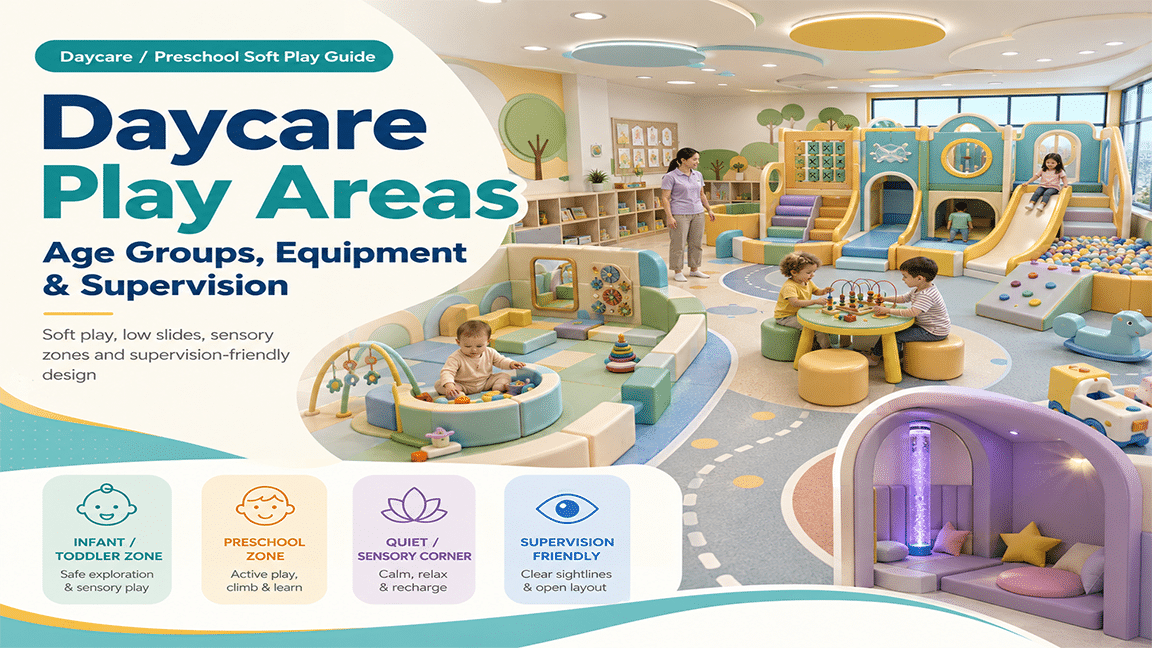
Young Children can experience Soft Play, Mini Climbing, and low-difficulty Obstacles.
Older Children & Teens can experience Ninja Course, Climbing Wall, and Rope Challenges.
Adults can participate in Team Building, Climbing Challenge, or Group Events.
This means that a Family Entertainment Center (FEC) can serve Family Visits, Birthday Parties, Schools, Corporate Groups, and Community Events at the same time.
The wider the customer base, the lower your dependence on the single-age market, and the easier it is to increase Weekday Traffic and Group Booking Revenue.
Indoor Adventure Parks do not necessarily mean that the operating cost is lower than that of a Trampoline Park, but a reasonable combination of equipment can help control some long-term costs.
For example, some fixed Indoor Adventure Park equipment does not have a large number of continuously moving Springs or Trampoline Beds, so the daily wear patterns of some parts will be different.
Modular design can also bring advantages. When an Attraction needs to be upgraded, you may only need to replace some Obstacles or Interactive Elements instead of rebuilding the entire venue.
However, you still need to consider:
Therefore, in the project planning stage, the Total Cost of Ownership (TCO) should be compared, instead of simply thinking that the purchase price or maintenance cost of Adventure Park must be lower.

When comparing Trampoline Park vs Indoor Adventure Park, Initial CAPEX is one of the first issues that investors need to consider.
The main investment of a Trampoline Park is usually concentrated in:
Commercial Trampoline Park Equipment
The investment structure of an Indoor Adventure Park is more diverse, because the projects may include Climbing, Ninja Course, Rope Course, Soft Play, and Interactive Equipment.
Therefore, there is no fixed “which one is cheaper” for the two models.
A simple Trampoline Park may cost less than a large Adventure Park, but a high-specification Trampoline Park that includes Performance Trampoline, Airbag, Ninja Course, and Interactive Games may also require higher CAPEX.
When obtaining a quotation, you should ask the supplier to provide a plan according to the same site area and target Capacity, so that the comparison can be practical.
Revenue per Square Meter is more suitable for judging the spatial efficiency of FEC projects than simply comparing Ticket Price.
Trampoline Park can earn revenue through higher Customer Turnover. Customers Usually Buy Tickets According To Fixed Sessions, Such As 60, 90, or 120 Minutes, So Operators Can Control Capacity Through Session Management.
An indoor adventure park can use a more diverse attraction mix to increase the reason for consumption and improve the density of the project through vertical space.
Your Revenue per Square Meter ultimately depends on:
Therefore, it is not possible to judge which project has a higher income based on the type of equipment alone.
For a market with high passenger flow and concentration of young consumers, Trampoline Park may have a strong Revenue Potential; while for a market with a high proportion of household consumption, Multi-project Adventure Park may be more likely to create diversified income.
Customer Dwell Time is very important for FEC Profitability, because the longer the customer stays, the more likely Secondary Spending is.
In addition to tickets, you can also get:
If customers quickly lose interest in a venue with only a single attraction, Secondary Revenue will be limited.
And with a reasonable Indoor Adventure Park Design or Hybrid Trampoline Layout, you can let customers move between different Attractions, thus extending the overall experience time.
However, the longer the Dwell Time, the better. You also need to balance Capacity and Customer Turnover. If customers stay for too long and do not generate additional consumption, they may reduce their income per unit of time during peak hours.
Therefore, a more effective strategy is to combine Dwell Time with F&B, Party, Membership, and Premium Activities, so that the stay time can really be converted into income.
If your site area is limited, you should first analyze Floor Area, Ceiling Height, Column Position, and Customer Capacity, instead of directly selecting certain equipment.
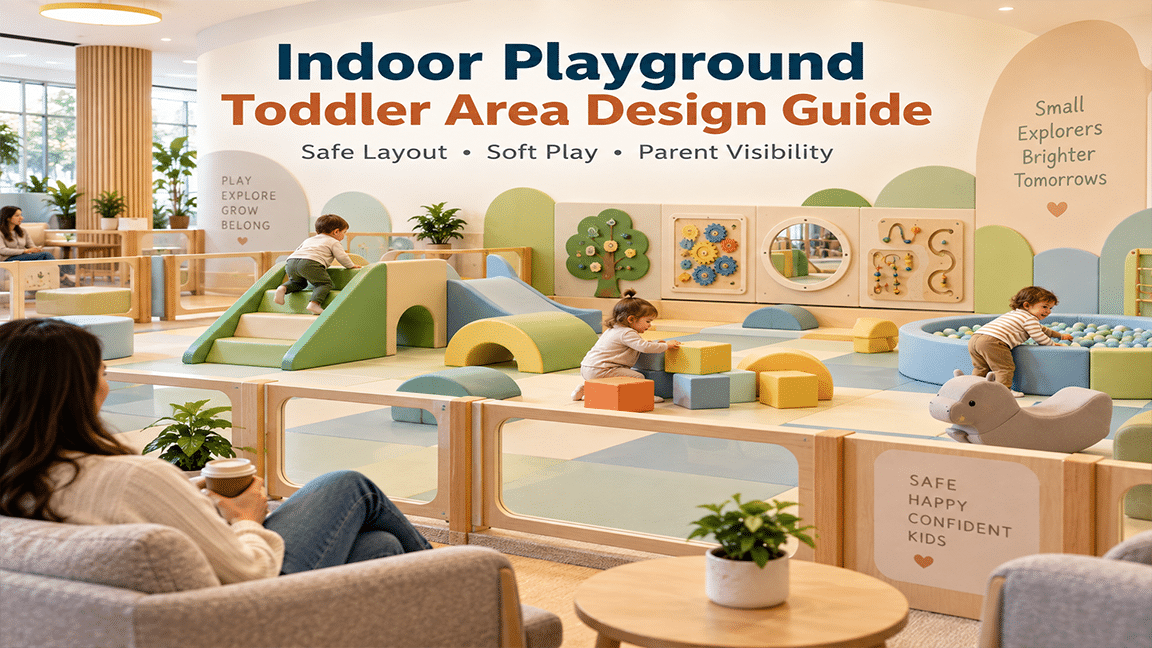
For Small and Medium Venues, pure large Trampoline Courts may take up more Floor Space. Therefore, if the space structure is complex, modular Indoor Adventure Park Equipment can often provide more Layout Flexibility.
You can use the wall and height to add Climbing, Ninja Elements, or Multi-Level Play to allow the limited space to accommodate more Attractions.
However, if the local market has a clear demand for Trampoline Activities and the site has sufficient open space and Ceiling Height, a compact Trampoline Park can also form a very clear commercial positioning.
Therefore, the most important thing for small projects is:
Instead of pursuing the number of equipment, pursue Space Efficiency and Revenue Efficiency.
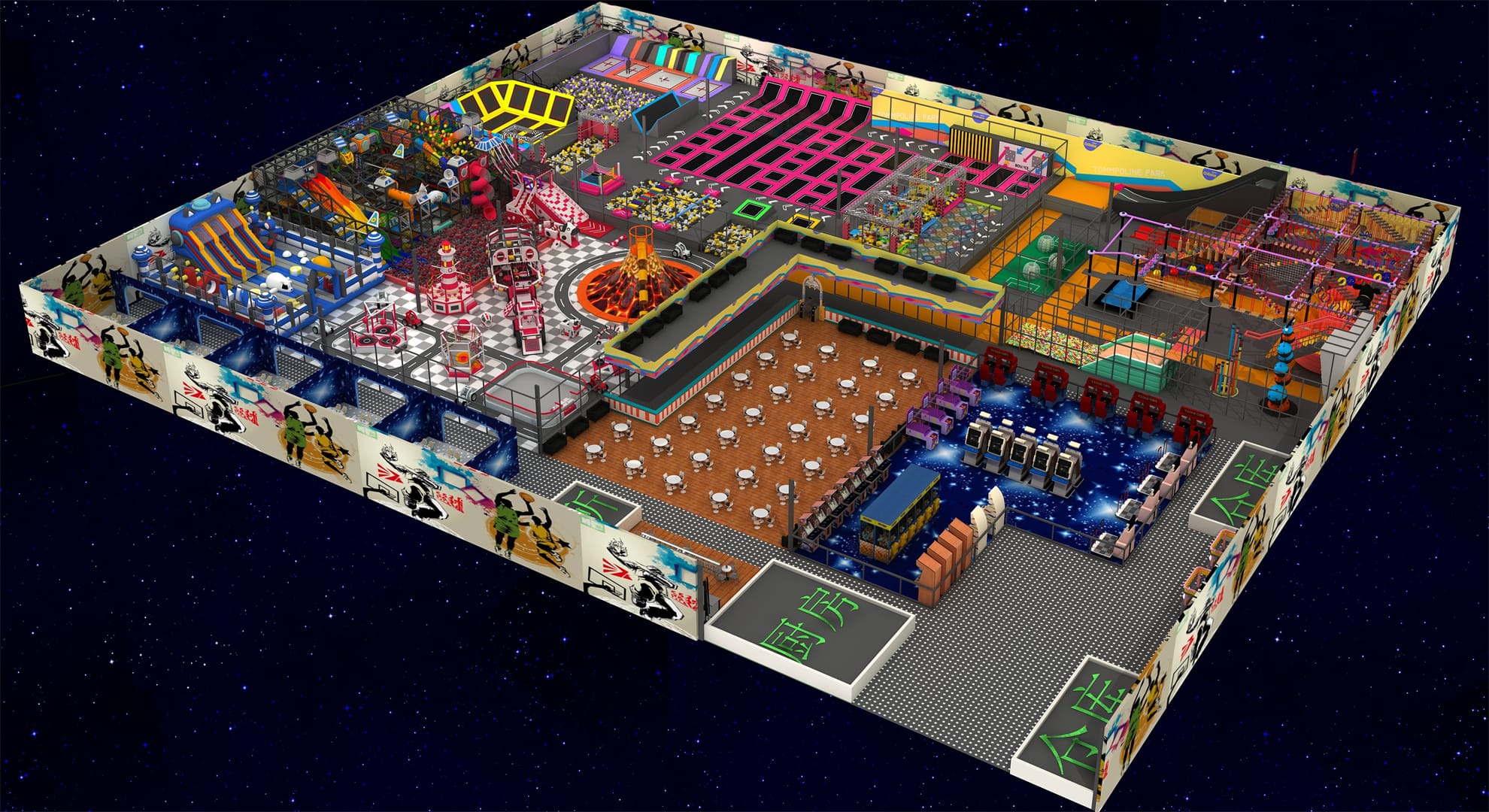
For a large Family Entertainment Center (FEC), simply choosing one or the other in Trampoline Park and Indoor Adventure Park is not necessarily the best strategy.
Large-scale projects have more space and can adopt a Hybrid FEC Model to:
Combine into the same entertainment center.
This model can cover different ages and consumer needs, and also reduces the risk of the whole project relying on a single Attraction.
For example, teenagers can enter Trampoline and Ninja Zone, young children can use Soft Play, and parents can stay in Café and rest areas.
Therefore, for large-scale projects, professional Indoor Adventure Park Design should start from Customer Journey, Capacity, Age Zoning and Revenue Mix, rather than simply stuffing more equipment into the site.
If your goal is to build a long-term integrated FEC, the Hybrid Model is usually worthy of priority evaluation.
A trampoline park usually requires a floor height of 5–8 meters, while the floor height requirements of an indoor adventure park are more flexible, mainly depending on the specific Attractions.
Trampoline Park usually needs to pay higher Insurance Costs because of its high Injury Risk, while the cost of Indoor Adventure Park depends on the specific Attractions and Safety Design.
Yes. Combining Trampoline Attractions with Adventure Activities can create a more diversified FEC and attract a wider audience.
Indoor Adventure Park usually has more Secondary Revenue opportunities, including F&B, Birthday Parties, Memberships, Retail, and a variety of paid Attractions.
FEC Equipment should meet the corresponding Safety Standards according to the equipment type and target market, such as ASTM and EN 1176.
Most Indoor Adventure Parks or Trampoline Parks usually take about 3–6 months from Design, Manufacturing, installation, to opening preparation.
Which FEC Attraction Model Is Better for Your Business?
The most suitable FEC Model for you depends on the budget, target audience, venue, and revenue target. Trampoline Park is more suitable for Active Entertainment, while Indoor Adventure Park usually has more Attraction Variety and revenue methods.
If you want High-Energy Attractions, high passenger flow, and a mature Entertainment Model, you can choose Trampoline Park.
Choose an Indoor Adventure Park If…
If you want more diverse Attractions, a wider target audience, and more Revenue Opportunities, you can choose Indoor Adventure Park.
Choose NanPlay for Custom Turnkey FEC Solutions
If you need a customized Turnkey FEC Solution covering Design, Equipment, Manufacturing, and Installation, you can choose NanPlay.
Get free FEC Layout and ROI Analysis to help you assess the site, investment costs, and potential benefits before the project starts.
Get customized Equipment Proposals according to your FEC Space, Attraction Mix, Budget, and project needs.
Contact the professional Turnkey FEC Solution Provider for one-stop project support from Design, equipment selection, manufacturing, and installation.
Thank you very much for your inquiry! Your trust is our greatest motivation. We are committed to offering playgrounds that combine high quality with affordable pricing. Let us bring vitality to your venue!