21 September 2026
15 September 2026
14 September 2026

14 September 2026
14 September 2026
The indoor playground is a kind of playing place that children like to play, but if you want children to play safely, you need to have some safety rules that everyone to follow. These safety standards are the key part to protect children from injury. For those who do business of commercial indoor playgrounds, it is necessary to achieve safety compliance, because it will affect whether you can get a business license, whether you can pass the audit of insurance, and also help you control risks for a long time, and you can also make money. If the playground is not comply, you may be fined, asked to close down for rectification, or lose money in case of an accident.
This guide has sorted out some mainstream amusement park safety standards in the world, including ASTM, EN1176, CPSC and IPEMA. It talks about how to do materials, how to build, how to arrange the venue, how to operate daily life, and how to maintain equipment. These contents are written to help
Indoor amusement park safety standards can be understood as a set of unified safety requirements for the design, production, installation and operation of commercial amusement equipment. These standards are formulated based on many years of accident data and professional safety test results. It clearly stipulates many small details of amusement park operation, such as equipment What materials to use, whether the structure is strong enough, how to arrange the site, how to maintain it every day, etc., the purpose is to eliminate those places that may have problems in advance.
Because the commercial playground is different from the place where you play at home. It receives many children of different ages. There are many people who come to play, and the risk of accidents is relatively high. If it can be done according to safety standards, it can protect the personal safety of children, meet the regulatory requirements of the government, and get legal operating capital. And with standardized safety management, it can also reduce the liability risk that may be borne in operation, reduce the cost of insurance, and make parents feel more at ease to bring their children to play, so that the playground can make stable money in the long term.
It is a safety standard institution recognized all over the world. The amusement park safety standards issued by it are widely used in the United States and many other countries. These standards focus on whether commercial amusement equipment is strong, whether the structure is safe, and how to prevent risks in daily use.
EN1176 is a uniform amusement park safety standard in Europe, and it is mandatory and applicable to both indoor and outdoor amusement equipment. This standard is very strict about how much the structure can withstand, whether it will get stuck with children, how the impact resistance is, and whether the material is safe. It is an important reference standard for the safety of global amusement parks.
The CPSC Guide is a set of practical amusement park safety guidelines issued by the U.S. Consumer Product Safety Commission. It mainly focuses on on-site operation, how to detect hazards and how to prevent accidents. This guide is very detailed about the design, installation and daily management of amusement parks, which can be followed.
IPEMA is an authoritative third-party certification for play equipment. Products with IPEMA certification have passed strict ASTM standard tests, which is an important proof of qualified and safe commercial playground equipment.
ASTM F1487 is the core safety standard for American public commercial playgrounds. It formulates unified requirements for equipment design, manufacturing materials, structural stability, guardrail and handhold settings, and professional test methods, ensuring equipment can withstand long-term high-frequency commercial use and avoid structural failure.
EN1176 focuses on the overall structural safety of playground equipment. It mandates strict load resistance tests, anti-wear and anti-damage performance for long-term use, professional anti-entrapment design for gaps, and matching impact protection standards for falling risks, ensuring the stability and safety of the entire play system.
ASTM prioritizes the overall durability and wear resistance of materials to adapt to high-intensity commercial use. EN1176 specifies precise material thickness and hardness standards to prevent local breakage and deformation of equipment.
EN1176 simulates real multi-person simultaneous use scenarios for load testing with stricter bearing limit standards. ASTM adopts standardized static and dynamic load tests to verify equipment stability.
Both standards prevent finger, head and limb entrapment, but with different gap size parameters. EN1176 has more detailed limit values for child head entrapment, while ASTM covers more types of gap hazard scenarios.
All playground contact materials must be non-toxic, harmless and free of lead, phthalates and other harmful chemicals. Paints, plastics and soft materials cannot fall off into small choking pieces, and have no sharp edges or rough surfaces to avoid scratches and injuries.
As closed public spaces, indoor playgrounds require all soft padding, foam, fabrics and plastic accessories to meet fire-resistant standards. These materials can slow flame spread and reduce smoke emission, minimizing fire safety risks.
Commercial playgrounds have high daily usage, so all equipment materials must meet commercial-grade durability standards. They need to resist frequent friction, extrusion and impact, avoiding rapid aging, damage and failure caused by long-term use.
Metal equipment parts need professional anti-corrosion coatings to prevent rust and structural aging, ensuring long-term structural stability.
The steel frame is the core support of play equipment, requiring high-quality thickened steel and firm welding. The overall structure must be free of deformation, cracks and looseness to bear normal play loads.
Soft play PVC materials must be food-grade non-toxic raw materials, with good tear resistance and puncture resistance. The surface is smooth and wear-resistant, suitable for long-term contact with children.
Playground foam padding has clear density and thickness standards. Qualified foam can effectively absorb falling impact, avoiding hard contact injuries, and will not harden or lose protection after long-term compression.
Critical fall height refers to the highest accessible position of play equipment. Standards clearly define matching protection requirements for different fall heights: the higher the equipment, the higher the impact resistance of supporting facilities and ground materials.
Impact-absorbing flooring is the first line of defense against fall injuries. Qualified rubber floors, foam mats and poured-in-place rubber ground can buffer falling impact and greatly reduce the risk of fractures and bruises.
All soft play areas such as climbing structures and ball pits need standardized padding. The padding thickness and coverage must fully cover all possible falling positions without dead corners.
Each piece of equipment must reserve a sufficient independent landing zone. No other equipment, walls or obstacles are allowed in the zone to prevent secondary collisions when children fall or slide down.
Commercial rubber flooring is divided into tile type and integral pouring type. It must pass professional impact tests, adapt to different fall heights, and be durable, anti-slip and easy to clean.
Foam pits need to meet standard depth requirements to prevent children from hitting the bottom. The foam blocks are uniform in density, not easy to compact, and avoid suffocation and trapping risks.
The slide outlet landing area must be flat, soft and spacious enough to ensure children can stop stably after sliding down, without hitting walls or surrounding equipment.
Strict spacing standards are implemented between playground equipment to avoid excessive density. Sufficient moving space prevents children from colliding with adjacent equipment during running and playing.
The overall site layout needs to plan reasonable moving routes to avoid crowding and bottlenecks at slides, entrances and exits. It ensures orderly passenger flow and reduces collision risks in peak hours.
The playground design must ensure full open sightlines without blind corners. Staff and parents can clearly observe all playing children at any time, facilitating timely risk disposal.
Children of different ages have different play behaviors and physical conditions. Standardized age zoning avoids injuries caused by roug
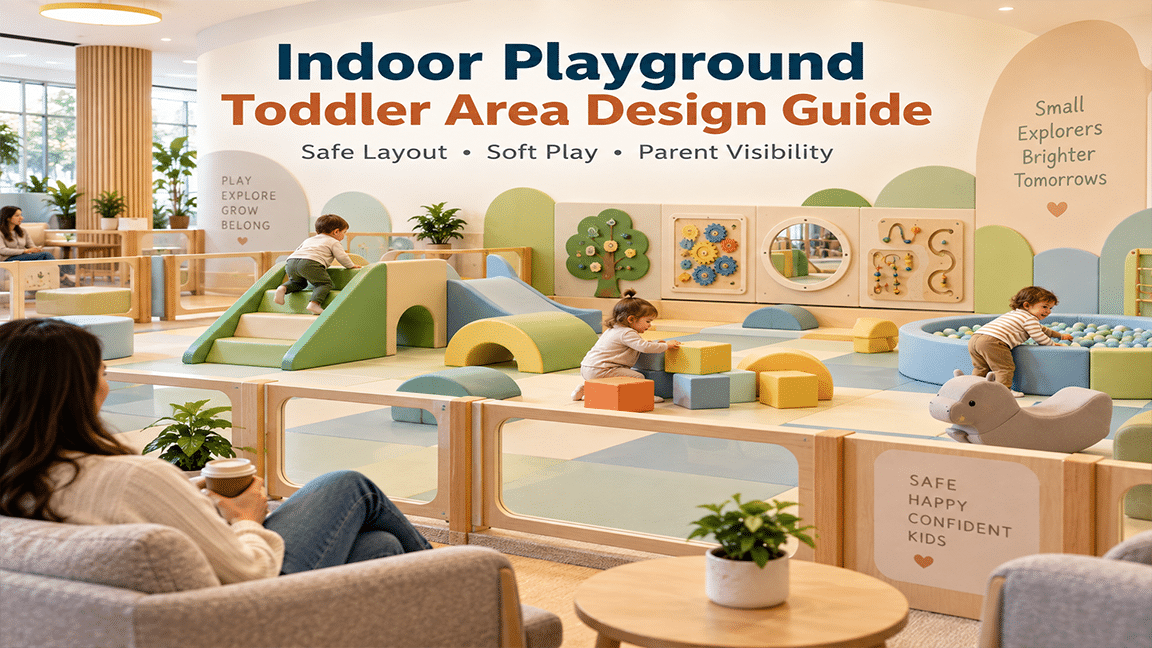
The toddler area is designed for children under 3 years old, with low equipment height, ultra-soft ground, small safe gaps and anti-climb barriers to prevent falling and trapping risks.
The 5-12 years old children’s area is independently separated from the toddler zone with obvious isolation facilities and signs to prevent cross-interference of play behaviors.
High-energy areas such as trampolines suitable for teenagers need independent closed isolation to prevent young children from entering by mistake and causing collision injuries.
Trampoline frames must be made of high-strength anti-corrosion materials with stable overall structure, no shaking or deformation. Springs and jumping mats are commercial-grade wear-resistant accessories to ensure stable bouncing performance.
All trampoline areas must be surrounded by high-strength safety nets without holes or damage. The nets are firmly installed to prevent children from bouncing out of the site and falling.
Trampoline jumping surfaces and bottom buffer structures need to meet impact absorption standards to avoid excessive bouncing pressure leading to joint or waist injuries, and prevent bottoming out during jumping.
Trampoline areas are designed with independent intervals for each jumping position, matching on-site management rules to avoid multi-person collisions and chaotic jumping risks.
A core safety rule: only one child is allowed to jump on a single trampoline at a time, which fundamentally avoids collision injuries between multiple jumpers.
Trampoline matching foam pits have fixed standard depth to ensure sufficient buffer space when jumping in, preventing hard contact with the bottom base.
All exposed frames, edges and corners of trampolines are fully covered with thick anti-collision padding to prevent bruises from accidental impact.

Professional certified teams must complete playground equipment installation in strict accordance with manufacturer specifications and safety standards. Unprofessional installation will cause hidden structural dangers even for qualified equipment.
After installation, all equipment must pass professional load testing to verify bearing capacity, stability and anti-tipping performance, ensuring adaptability to normal commercial use.
All large play equipment must be firmly anchored to the ground or wall with standard fixing parts to prevent displacement, shaking or tipping during children’s intense play.
Before official opening, the playground needs a comprehensive on-site safety inspection covering equipment, ground, layout and protective facilities to eliminate all potential hazards.
The pre-opening audit is a final compliance check, verifying that all facilities meet ASTM and EN1176 standards, which is a necessary condition for opening and insurance access.
Large and complex playground structures need professional engineering certification to confirm structural safety and compliance with building and safety codes.
A complete risk assessment report sorts out all possible safety hazards of the site, formulates targeted prevention and response plans, and standardizes operational safety management.
Playground staff must conduct daily pre-opening inspections to check for loose parts, damaged padding, broken nets and other visible hazards, and rectify problems immediately.
Establish a long-term wear monitoring mechanism for equipment, track the aging degree of soft materials, metal parts and connecting components, and avoid safety hazards caused by excessive wear.
Follow manufacturer’s official maintenance cycles, replace aging and damaged accessories regularly, and use only certified matching parts to ensure equipment safety consistency.
All on-site operators must receive professional safety training, master hazard identification, child safety supervision and emergency response skills to ensure standardized daily operation.
Vulnerable soft materials such as foam, padding and cloth covers have fixed replacement cycles. Timely replacement prevents protection failure caused by aging and compression.
Professional engineers conduct regular structural inspections every 1-2 years to check frame stability, anchoring firmness and welding integrity.
Establish complete inspection and maintenance records, archive all repair and replacement records, to facilitate compliance inspection and long-term safety tracking.
Commercial playgrounds must purchase professional liability insurance. All safety compliance certificates and inspection reports are necessary prerequisites for insurance underwriting, which can effectively reduce operational liability risks.
Playground operation must comply with local commercial operation laws and safety supervision regulations. Only by meeting standard requirements can we obtain legal operating qualifications and avoid administrative penalties.
Official opening requires equipment safety certification, fire safety certification, pre-opening inspection report and other qualified documents to complete industry approval.
Indoor playgrounds, as crowded public places, must strictly comply with government safety supervision and fire protection regulations to ensure public safety.
The site construction meets local building code standards in terms of floor height, structural bearing, emergency exits and passage width.
Equipped with qualified fire extinguishing equipment, smoke induction devices and clear fire exit signs. All interior materials meet fire-resistant grading standards.
Complete public safety inspection and certification by government departments before opening, and pass regular annual safety reviews.
Many operators only pay attention to local basic regulations and ignore authoritative international standards such as ASTM and EN1176, resulting in insufficient safety redundancy and potential accident risks.
Pursuing low cost and choosing unqualified cheap materials and equipment will lead to poor durability, unqualified protection performance and frequent safety hazards.
Unreasonable site layout, dense equipment placement and missing age zoning cause frequent crowding and cross-collision accidents, failing to meet safety specifications.
Self-installation or irregular team installation leads to loose equipment, unstable structure and unstandardized protection settings, burying long-term safety hazards.
Too narrow spacing between equipment does not reserve safe moving and falling buffer space, which is a common compliance violation.
Cutting corners on ground flooring and padding leads to unqualified fall protection, unable to buffer impact and causing accidental injuries.
Lack of standardized daily inspection and regular maintenance plans, only repairing after damage, resulting in long-term hidden dangers of aging equipment.
Cooperate with formal manufacturers with ASTM, EN1176 and IPEMA certifications to ensure all equipment is produced in line with international safety standards.
Take the initiative to ask suppliers for official equipment test reports and safety certificates to verify product compliance and avoid unqualified products.
Hire professional playground design teams to complete site layout, zoning and equipment matching, ensuring full compliance with safety design standards.
Arrange regular third-party safety audits throughout the operation cycle, timely discover and rectify potential hazards, and maintain long-term compliance.
Sort out a complete safety standard checklist before construction, covering materials, structure, layout and fire protection, to avoid compliance errors in the early stage.
Complete manual verification and professional testing after installation to confirm all equipment and facilities meet standard requirements.
Establish a long-term safety monitoring mechanism, standardize daily operation and maintenance, and ensure continuous compliance of the playground in the whole operation cycle.
What are indoor playground safety standards?
They are a set of unified safety guidelines for indoor playground design, production, installation and operation, covering materials, structure, protection, layout and maintenance to prevent child play injuries.
What flooring is required for indoor playgrounds?
Indoor playgrounds need impact-absorbing commercial floors such as rubber tiles, poured rubber and high-density foam mats, matched according to different equipment fall heights.
How often should playground equipment be inspected?
Daily visual inspections by on-site staff, and at least one professional comprehensive structural and safety inspection every year.
What certifications are needed to open a playground business?
Mainly including equipment safety certification, IPEMA certification, fire safety certification and pre-opening safety inspection qualification report.
What is the difference between ASTM and EN1176 standards?
ASTM is a U.S. standard focusing on commercial durability and comprehensive risk prevention; EN1176 is a European standard with stricter specifications for structural load, gap anti-entrapment and impact protection data.
Safety standards are a very important foundation for business playgrounds. Only by honestly complying with international and local safety standards can we really protect the safety of children and slowly make a good reputation so that parents are willing to believe you.
After compliance, the security will be improved, and the profitability will also be better; making safety management more standardized can greatly reduce the cost of accidents and losses, and also reduce the cost of insurance. The equipment is not easy to break down, and there is less time to stop business and repair things, so that the business can always make money.
Finally, a little advice to the investors and operators of the amusement park is that you should never cut corners in safety. You must cooperate with certified manufacturers and professional design teams. From construction, installation to daily maintenance, the whole process should be strictly compliant, and the safety standards must be regarded as growth. The core of the period operation is done.
But remember, NanPlay can help you solve most of your safety standard problems.
Thank you very much for your inquiry! Your trust is our greatest motivation. We are committed to offering playgrounds that combine high quality with affordable pricing. Let us bring vitality to your venue!