30 October 2026
30 October 2026
30 October 2026
23 October 2026
23 October 2026
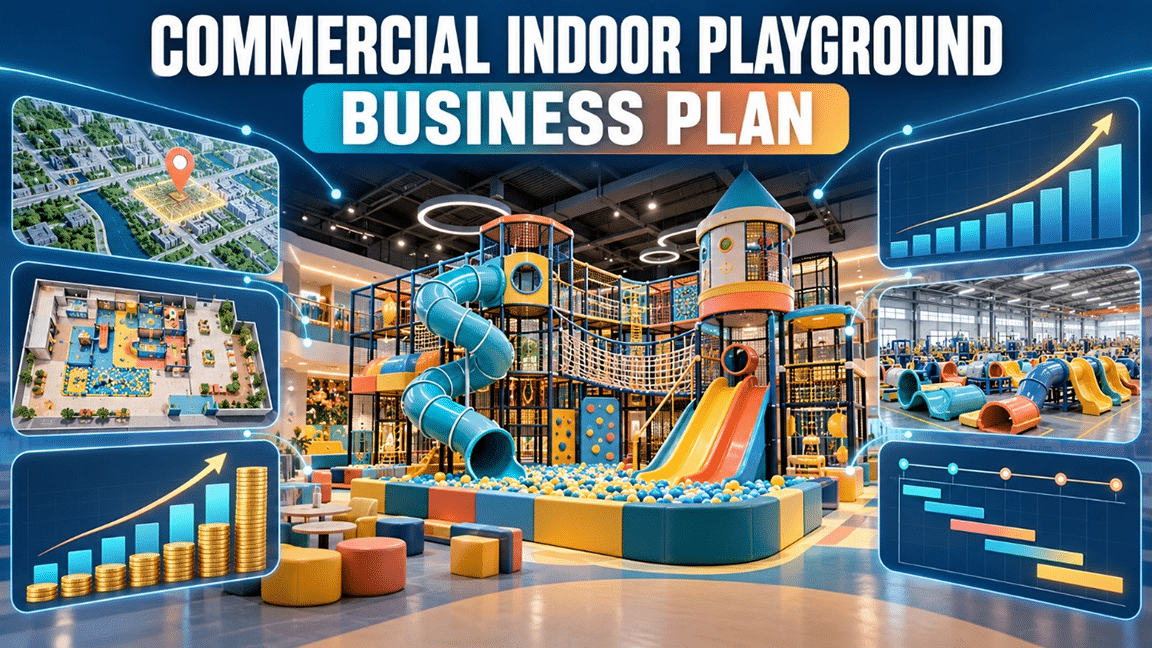
A reliable business plan for an indoor amusement park should include thorough local market research, an on-site site survey, budgeting for the amusement equipment, and planning for diverse revenue sources. At the same time, criteria for selecting suppliers should be set. The plan should clearly outline the equipment to be purchased, and the financial calculations should be realistic and not promise fixed returns. It will also explain the thinking process for selecting suppliers and choosing suitable equipment, providing important references for investors, landlords, and procurement managers.
A complete business plan for an indoor amusement park must include market analysis, site conditions, equipment list, start-up capital, revenue planning, supplier evaluation, and project schedule. All core calculations must be based on real data and cannot rely solely on subjective speculation.
| Business-Plan Input | Supporting Evidence | Cost Assumptions (Non-Guaranteed) | Revenue Assumptions (Non-Guaranteed) |
| Local market demand | Local family demographics, competitor research, drive-time trade-area data | Lease deposit, monthly rent, fit-out expense | Estimated daily visitor volume based on local family population |
| Play equipment scope | Supplier quotations, 2D/3D layouts for Indoor Playground Equipment | Commercial Playground Equipment, shipping, installation | Income from open play, memberships and private events |
| Site parameters | Floor plan, ceiling height, pillar positions, exit layout | Renovation, safety flooring, site preparation | Capacity limits based on venue maximum occupancy |
| Supplier & timeline | Quotation lead times, factory production cycles from your Indoor Playground Supplier | Design fees, spare-parts budget, certification expenses | Projected opening month for revenue start-up |
Note: All figures are planning references only and do not represent guaranteed business outcomes for your Commercial Indoor Playground.
Market research forms the foundation of your Commercial Indoor Playground business plan before you select any Indoor Playground Equipment.
First, determine the business district. The driving time is generally between 15 and 25 minutes. Count the families with children of the appropriate age, and investigate the surrounding competitors: other indoor amusement parks, FECs, family coffee shops, trampoline parks. Note down their pricing, equipment, operating hours, and reputation.
Identify the market gaps, such as the lack of a children’s section, which will help you select competitive amusement equipment. Do not simply copy the global industry trends; the plan should be tailored to local conditions.
To make a profit, the location of an indoor amusement park needs to be good. Before signing the lease contract and purchasing equipment, please make sure to check the three key site conditions.
The areas of passageways, front desks, activity rooms, and bathrooms should be excluded. Only the actual play areas should be counted.
For children’s small playgrounds, the area should range from 150 to 200 square meters; for adult entertainment centers (FEC), the area should be at least 300 to 500 square meters. The available area of the venue determines how many entertainment facilities can be safely set up.
If the ground height is insufficient, multi-level climbing frames cannot be built. For the area for young children, the net ground height should be at least 2.8 meters; for multi-level facilities targeting older children, it should reach 3.5 meters or higher. Before requesting the supplier to provide the layout plan, please make sure to confirm the net ground height first.
Check the rent, lease term, deposit, and rent increase terms. Evaluate the parking space, convenience of using baby strollers, the flow of people, and the availability of family-friendly stores in the vicinity. Even in high-rent areas, with excellent indoor recreational facilities, it is difficult for families to make profits.

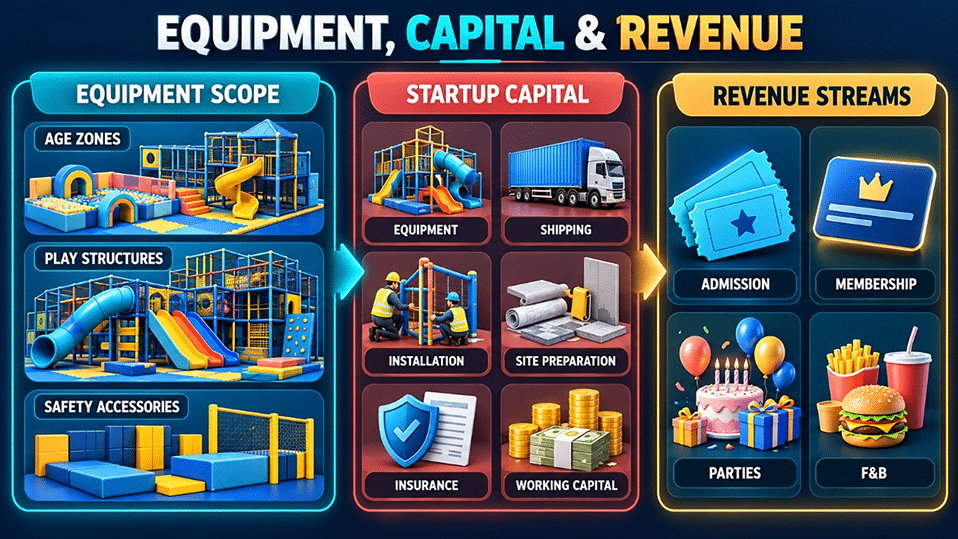
According to the age group targeted and the available space of the venue, select appropriate recreational equipment.
For the low-children area, choose low and soft facilities, soft building blocks, shallow pool areas, and small slides; if it is a mixed-age play area, separate the low-children play zone from the high-level climbing frames, obstacle courses, and interactive equipment.
Safety accessories cannot be missing: guard nets, anti-slip floor mats, and isolated guardrails with soft covers.
When communicating with suppliers, determine whether to choose standard modules or customize a themed solution. At the same time, confirm the material parameters, safety certifications, and include the budget for spare parts and accessories.
Sort out the startup funds for the indoor amusement park item by item. The price difference for commercial amusement equipment is significant. The cost for a small standardized module area starts at 20,000 US dollars, while the cost for a large customized FEC complete set of equipment can exceed 300,000 US dollars.
In addition, there are many other expenses: freight, installation fees, site renovation, safety mats, and various licensing fees. Before opening, you also need to prepare a deposit, insurance, promotion expenses, and working capital reserve.
It is recommended to get detailed itemized quotations from amusement equipment suppliers. Do not simply estimate the cost based on the per-square-meter price when the layout plan has not been determined.
Having multiple sources of income can reduce the operational risks of indoor amusement parks.
This plan lists all the profitable projects, objectively assesses the income, and does not guarantee reaching a specific profit level.
A single ticket is your main source of income. Please calculate the capacity limit of the amusement park and do not overestimate the number of visitors.
Monthly or annual membership packages to drive repeat visits and predictable cash flow. Memberships improve customer retention for family-oriented venues with high-quality Commercial indoor Playground Equipment.
Birthday parties and venue bookings are also good sources of income. Such orders usually have higher profits. When communicating with the equipment suppliers about the layout plan, you can plan a separate party area in advance.
We sell coffee, snacks, and beverages. The catering service can supplement the ticket revenue, but please be sure to understand the local catering licensing requirements in advance.
It is very important to choose a reliable indoor playground supplier of amusement equipment.
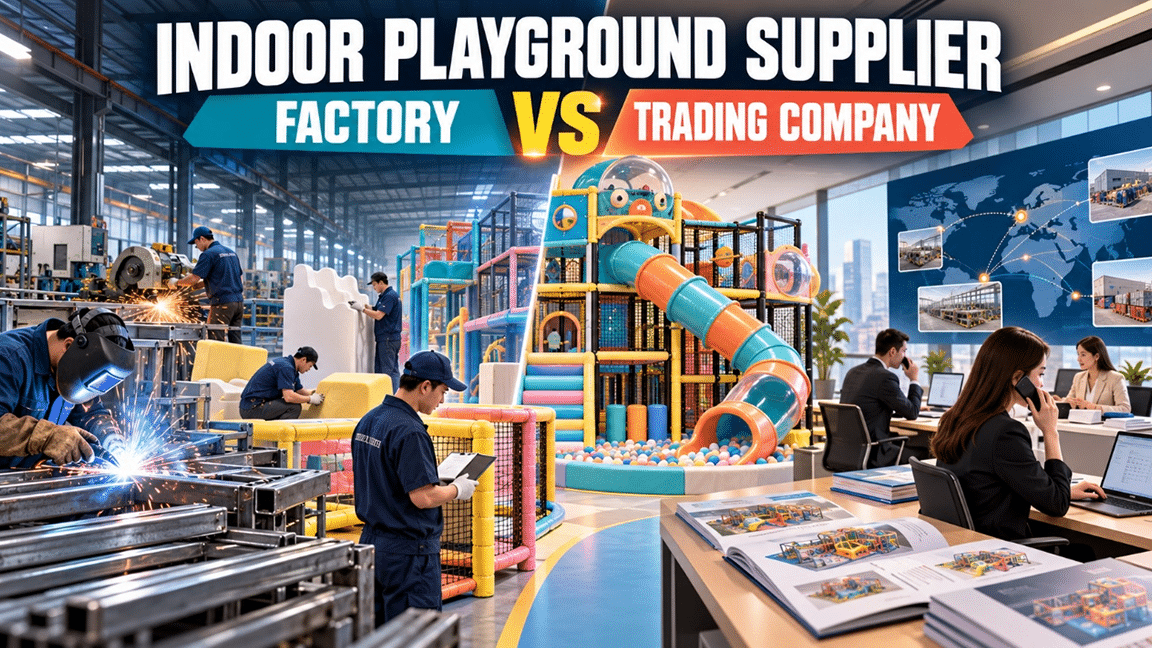
When selecting, it is necessary to distinguish between the original factory and the trading middlemen, and verify the factory’s production capacity, overseas implementation projects, and complete safety certifications.
Confirm in advance whether the other party can provide two-dimensional layout diagrams, 3D effect pictures, and that custom-made products usually take 45-60 working days, as well as installation plans and subsequent spare parts supply.
Regular factories like NanPlay can provide one-stop complete services. Don’t just make a decision based on the lowest price; compare several quotations before making a decision.
It would be advisable to include a clear project timeline in your business plan, listing all the important milestones leading up to the opening of the business.
During both the construction and production phases, there is a possibility of delays. Remember to set aside some buffer time to deal with unexpected delays.
Before contacting the suppliers of amusement equipment, make sure to prepare the following materials:
Complete floor plans of the venue, the actual usable area, floor height, positions of columns and safety exits;
The age range of the children the venue is intended for, the maximum number of people it can accommodate, the equipment needed, whether it will be in standard modules or customized themes;
The initial budget, the planned opening date, and the local mandatory safety regulations.

・Assuming excessive optimism about revenue without conducting thorough local market research
・Failing to include transportation costs, installation fees, venue decoration expenses, insurance costs, and working capital in the budget
・Choosing amusement suppliers solely based on price, without verifying the factory’s strength, material parameters, and safety certifications
・Ignoring the floor height restrictions of the venue when planning multiple amusement facilities
・Omitting spare parts and maintenance costs from the budget
・Signing the venue lease without having reviewed the layout plan with experts in the amusement industry
A reliable business plan for an indoor amusement park should include market research, site assessment, equipment list, budget, revenue forecast, supplier selection criteria and project schedule.
The budget reference should use the actual breakdown quotations provided by the suppliers, and not simply copy the estimated figures from the general template.
The total investment for the project depends on the size of the venue, whether a theme customization is required, and various additional expenses.
The budget for a small indoor amusement park starts at approximately $50,000 – $120,000; the investment for a medium-sized FEC family amusement park may exceed $300,000. It is recommended to obtain detailed itemized quotations from the suppliers to further refine your financial plan.
Whether it can make a profit depends on factors such as location selection, competition in the surrounding area, cost control, the volume of visitors, and operational efficiency. There is no guarantee that it will definitely make a profit. When planning the budget for amusement equipment, it is recommended to make an actual-based estimate.
Match Indoor Playground Equipment to your target-age visitors and usable site space. Include core play structures plus mandatory safety accessories. Decide between standard modular or custom-themed builds. Discuss layout suggestions with your Indoor Playground Supplier for your Commercial Indoor Playground.
Before placing an order for commercial amusement equipment, it is necessary to first investigate the local family customer base, the situation of competing products, the maximum capacity of the venue, the scale of the flow of visitors, the total start-up funds, as well as the local safety regulations.
・ Conduct market research in the local area and identify competitors
・ Record key information about the venue: floor plan, available playing area, floor height, columns, and exit locations
・ Determine the age range of the target audience and the necessary equipment configuration
・ Calculate the equipment budget separately and distinguish it from shipping costs, installation fees, and venue preparation expenses
・ Verify the qualifications, project cases, and safety certifications of each equipment supplier one by one
・ Prepare a project schedule and reserve buffer time to deal with delays
・ Maintain conservative and objective revenue estimates and do not make profit promises
・ Confirm local safety regulation requirements before finalizing equipment parameters
Setting up an indoor amusement park requires a comprehensive business plan. The plan should include market data, site limitations, selection of amusement equipment, revenue planning, and supplier verification, among other things.
Financial projections are merely hypothetical assumptions and do not guarantee a guaranteed profit. When making the budget, it should be calculated based on the actual quotations for the amusement equipment and related projects.
Thank you very much for your inquiry! Your trust is our greatest motivation. We are committed to offering playgrounds that combine high quality with affordable pricing. Let us bring vitality to your venue!