30 October 2026
30 October 2026
30 October 2026
23 October 2026
23 October 2026
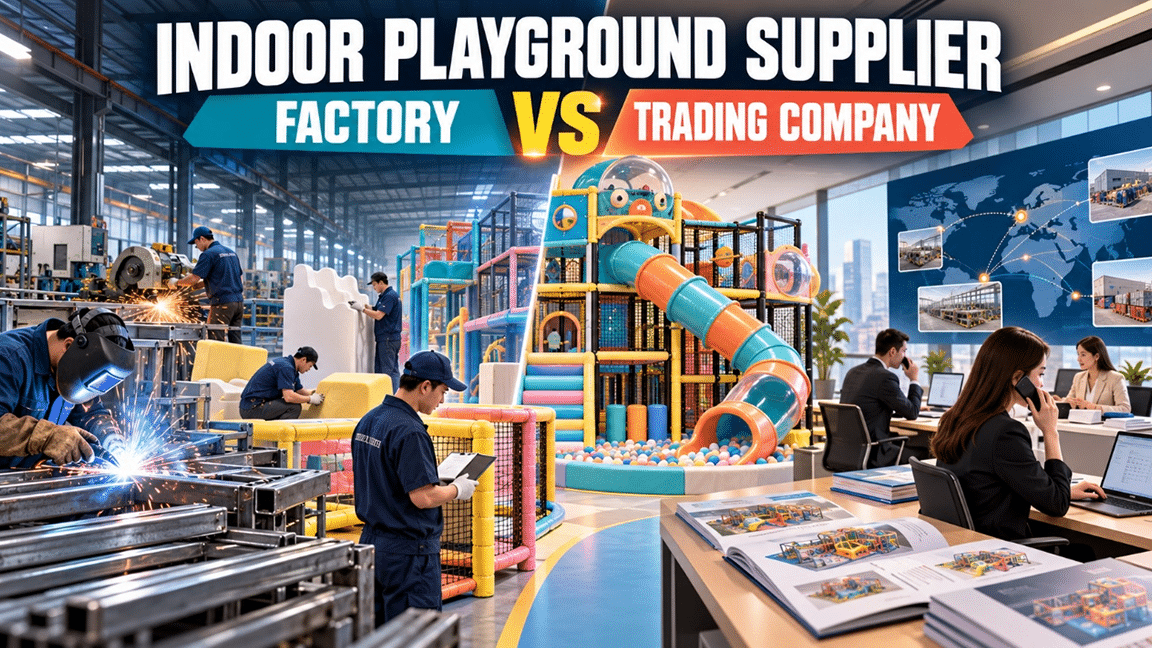
Quotes for indoor playgrounds can vary widely, even for similar-looking projects. Resist choosing based purely on the lowest price, as hidden costs, different material grades, incomplete equipment scope, and uneven after-sales support will affect your total long-term spend.
Compare item-by-item: full equipment scope, written material specs, logistics, installation, warranty, and safety certifications. Always share identical project requirements with every supplier to achieve a fair comparison. Work with verified manufacturers to safeguard your investment and lower future operational risks.
Many buyers confuse trading companies with real manufacturers when buying playground equipment. Genuine factories make the equipment themselves. Traders act as middlemen, sourcing products from partner factories and reselling overseas. This difference in production control and responsibility may lead to quality, delivery, and after‑sales risks for your playground project.
| Comparison Item | Real Playground Factory | Trading Company |
| Production Control | Owns workshops, machinery, and production staff; controls the full manufacturing workflow | No production facility; fully relies on external subcontract factories |
| Customization | Supports theme design, dimension adjustment, OEM & ODM for Commercial Playground Equipment | Limited customization; mostly offers standard modules, subject to factory schedules |
| Delivery | Directly manages production progress; transparent lead-time tracking | Cannot fully control manufacturing timelines; information passes through multiple parties |
| After-sales Support | Direct access to engineering teams; provides spare parts, maintenance guidance, and technical support | Relays problems to third-party factories; response speed and accountability may be weakened |
Production control determines the safety and durability of your Indoor Playground Equipment. Only real factories can supervise every critical production link for your Commercial Indoor Playground.
Qualified factories select raw materials in-house. Reputable manufacturers such as NanPlay adopt 2.0-2.5 mm galvanized steel frames, high-density EVA foam, non-toxic PVC leather, and food-grade PE panels for Commercial Playground Equipment. Trading companies cannot guarantee raw-material standards; they can only accept whatever materials their subcontractors use. Always ask suppliers to provide detailed material parameter sheets in quotations.
Capable factories handle the full production workflow: steel cutting, welding, powder coating, soft pad making, assembly, and testing. NanPlay runs a 20,000 m² production base with a complete in‑house line for playground equipment. Traders have no workshops of their own and outsource all production. This makes it hard for buyers to monitor manufacturing directly.
Real manufacturers carry out quality checks during production and final inspections before shipment. We can provide ISO 9001, ISO 14001, CE, EN1176, ASTM F1918, and third‑party test reports from SGS or TÜV for playground projects. Traders rely fully on subcontract factories for quality control and often do not have complete original certificates and test data.

If your indoor playground needs theme customization, custom sizing for odd-shaped spaces, or multi-age zone planning, pick a capable factory-direct supplier first. It speeds up delivery and cuts miscommunication.
Factories have their own designers and engineers. They create custom 2D layouts and 3D renders, adjust equipment sizes, and refine themes and colours. NanPlay provides full turnkey custom solutions and has finished 1,000+ projects across 50+ countries.
Traders have to pass custom requests to outside factories. Messages can get lost or misinterpreted, so the final product may not match the drawings. Complex or large projects carry higher risk when you work through an intermediary.
Commercial play equipment prices vary due to material quality and the supplier’s business model.
Factory direct sellers price based on actual production costs with no middleman markup. Their quotes separate fees for equipment, design, packing, shipping, and installation for easy budget planning.
Traders add service fees to factory prices and may hide extra costs. A low upfront quote can lead to later charges for design changes, spare parts, or technical support. Some use cheaper subcontractors to keep profits high. Always verify material specs, production standards, and included services.
Note: This does not mean every factory’s price is the lowest. Buyers still need to compare material specifications and service scope instead of only comparing total prices.
Custom indoor playground equipment normally takes 45‑60 working days to make, depending on how complex your project is.
Factory‑direct suppliers manage production schedules in‑house. They update buyers on progress and adjust timelines based on project priorities. Once production finishes, they handle export‑grade packing and arrange shipping.
Traders cannot control factory timelines directly. If their partner factory gets overloaded, your order may get delayed, with few ways to fix it. Information has to pass back‑and‑forth for packing lists and shipping papers, which can cause further hold‑ups.
Installation and ongoing after‑sales service are critical for your playground’s daily operation.
Trusted manufacturers such as NanPlay supply installation guides and remote technical help, plus overseas on‑site installation upon request. They keep original drawings to supply matching spare parts and maintenance tips. Steel frames carry a 3‑5 year warranty, soft padding 1‑2 years, all stated in the contract.
Traders cannot fix technical issues by themselves. They have to pass problems to subcontract factories, slowing responses and blurring responsibility. Getting suitable spare parts on time also depends on the original factory’s cooperation.

Before signing contracts, verify whether your Indoor Playground Supplier operates actual manufacturing capacity to avoid purchasing Indoor Playground Equipment from disguised trading companies.
Request factory workshop videos, real-time virtual tours, or factory-visit invitations. A genuine factory can show steel-processing workshops, soft-padding production zones, and finished-goods storage areas for Commercial Playground Equipment.
When verifying the supplier, you can request them to provide photos of their production equipment, welding operations, and assembly sites. NanPlay has over 150 professional employees and is equipped with complete playground manufacturing facilities. In contrast, the content displayed by trading companies is usually focused on their office premises and sales teams.
Check real global project references matching your venue type: malls, FECs, preschools, or resort play zones. Ask for on-site project photos, client feedback, and delivery records. NanPlay holds 14+year industry experience with over 1000 completed projects across 50+ countries for Commercial Indoor Playground.
Ask suppliers for sample inspection reports, material test records, and certifications like ISO, CE, ASTM, SGS, and TÜV. Trusted manufacturers provide complete original documents matching your target‑market rules. Traders mostly forward documents from their partner factories, so verify each document’s source and valid scope.
There is no one-size-fits-all solution when picking an indoor playground supplier.
If you are building a large-scale or themed commercial indoor playground, with strict standards for material quality and safety compliance, steady spare-parts supply and long-term technical support, or dealing with substantial project investment that demands clear single-party accountability, verified factory-direct suppliers are your recommended choice.
Trading companies can work for small-volume orders with standard products and little customisation. Yet this model means communications spread across multiple parties, and buyers hold limited control over technical details and production workflows. For most FEC and mall-based amusement projects, partnering directly with a qualified manufacturer tends to be more dependable.
Prepare these documents before contacting any Indoor Playground Supplier, whether factory or trading company:
Suppliers receiving identical briefs can deliver comparable proposals for your Commercial Playground Equipment.
· Choosing indoor playground suppliers just from website photos, without checking how big their factory is or what they can actually produce
· Going for cheap quotes without figuring out if the seller is a real factory or just a middleman
· Shopping for play gear only by price, and skipping checks on material standards and safety certificates
· Not sorting out after‑sales help, spare‑part availability, and warranty rules before buying
· Not stating clearly in the contract who actually makes the playground equipment
· Believing marketing words like “factory‑direct price” without asking for proof of their factory

For most commercial indoor playground projects, buying directly from the factory is the safer choice. Real factory-direct suppliers give you clearer oversight over quality, custom designs, production schedules, and after-sales help. Still, reliable traders are an option for small orders of standard off-the-shelf gear with no complicated custom changes.
Ask suppliers for workshop videos, production‑site photos, real project references, material test reports, and safety certificates. Confirm they have a complete production line for commercial playground gear. If an on‑site factory visit is not possible, ask for a remote virtual tour to verify their actual production strength.
Factories cut out middleman markup, but total cost still depends on material grade and service scope. Not every factory offers the lowest price for Indoor Playground Equipment. Buyers should compare the full quotation scope instead of only chasing the lowest headline price for your Commercial Indoor Playground equipment.
Yes. Professional factories usually offer OEM and ODM customization services for commercial amusement equipment, allowing for adjustments to the overall layout, equipment size, theme color scheme, and combination of amusement units according to the site conditions. NanPlay also provides complete 2D layout design and 3D rendering services for global buyers.
This cooperation model creates messy accountability. The trading company signs your contract, but a third-party factory builds the equipment. If quality problems occur, the two sides may shift blame to each other. This slows down repairs and makes problem-solving far harder for your playground project.
Picking the right supplier is a critical step before launching your commercial indoor playground project. Manufacturers and trading companies show big gaps in quality control, custom‑build ability, reliable lead times, and long‑term after‑sales service. For FEC venues, mall play zones, and kindergarten playgrounds, going with proven, experienced factories helps lower risks and protects your long‑term investment in play equipment.
Thank you very much for your inquiry! Your trust is our greatest motivation. We are committed to offering playgrounds that combine high quality with affordable pricing. Let us bring vitality to your venue!