14 September 2026

14 September 2026
1 September 2026
2 September 2026
2 September 2026
To make a children’s play area well, several things must be provided, such as equipment suitable for children’s play, softer ground, parents can clearly see their children, separate areas, and easy-to-clean materials. The core is two things: one is to separate children from older children, and the other is to let parents see where their children are at any time.
If you are a B2B buyer who is planning an indoor playground, you should know that children are different from children of other ages. They are curious, walk unsteadily, and have no concept of danger. 7-year-old children play with the right equipment, and 2-year-old children may encounter safety hazards.
A good children’s area is not achieved by shrinking the main playground. It should be a separate area with a lower height, softer ground, and equipment suitable for the developmental stage of children. If the design is good, you can retain a group of the most loyal customers. Children’s parent-teacher conferences come every week. If the design is not good, there will be injuries and complaints, and parents will never come again.
This guide will talk about how to design a children’s play area from beginning to end, from what equipment to choose, how to arrange the layout, to what materials to use, and what safety standards.
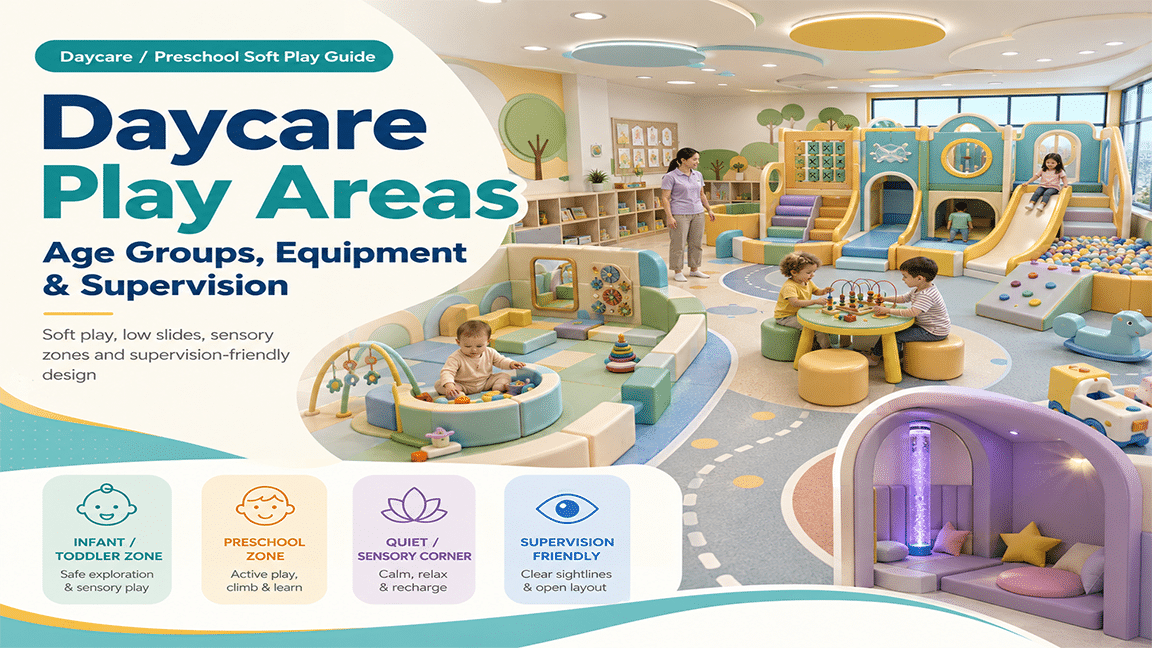
The children’s play area is designed for children from about 18 months to 4 years old. Children in this age group are developing large motor skills, walking, climbing, balancing, running, and learning through sensory exploration and repeating the same movements.
Children need a predictable and low-impact area to practice climbing, walking, stepping, and sliding in it. They don’t have to worry about being hit by older children. Their concentration time is also relatively short, so the equipment should provide simple and repeatable activities, not the kind of adventure route that takes a long time.
The difference is not only that the slide is smaller, but also that there are several obvious characteristics of the children’s area:
Lower to the ground – Maximum fall heights are typically under 24 inches.
Fully enclosed – Clear boundaries prevent toddlers from wandering into older children’s areas.
Softer – Impact-attenuating surfacing with a minimum 6-inch depth is standard.
More visible – Parent sightlines are prioritized so adults can supervise easily.
Simpler in design – Short, repeatable movement loops rather than complex multi-level structures.
Children’s safety areas must be separated from older toddler play areas to prevent collisions and excessive stimulation. Mixing different age groups together is the most common and dangerous mistake in the design of amusement parks.

Soft-packed amusement is the foundation of any children’s area; that is, it is made of foam and covered with a layer of durable PVC material. It is soft, impact-resistant, and has no hard edges, including foam climbing facilities, drilling tunnels, and soft-packed activity panels.
Soft-packed amusement is the foundation of any children’s area; that is, it is made of foam and covered with a layer of durable PVC material. It is soft, impact-resistant, and has no hard edges, including foam climbing facilities, drilling tunnels, and soft-packed activity panels.
The marine ball pool is a children’s favourite. It provides strong sensory stimulation and can also make children move. Use lightweight BPA-free balls. The ball pool should not be too deep. It should be ensured that children can stand up. Soft blocks can be stacked and pushed down, and the cause and effect can be understood when playing.
Children learn through the senses. There are different textures, sounds, and colours on the sensory wall, which can stimulate their desire to explore. The activity panel is equipped with shape pairing, rotating gears, and mirrors. The little hands are busy, and a quiet corner is also left with a cushioned bench to give the tired children a place to rest.
Toddlers are small, and the equipment should also be small. The maximum falling height should be kept below 24 inches, and the platform, slide, and climbing elements should be closer to the ground. In this way, the fall is not serious, and the child will be bolder to play.
Children need to know where to go and where not to go. Use low fences, soft walls, or ground of different colours to mark the area. The children’s area should be surrounded as a whole, and children will not run to the area of the big child.
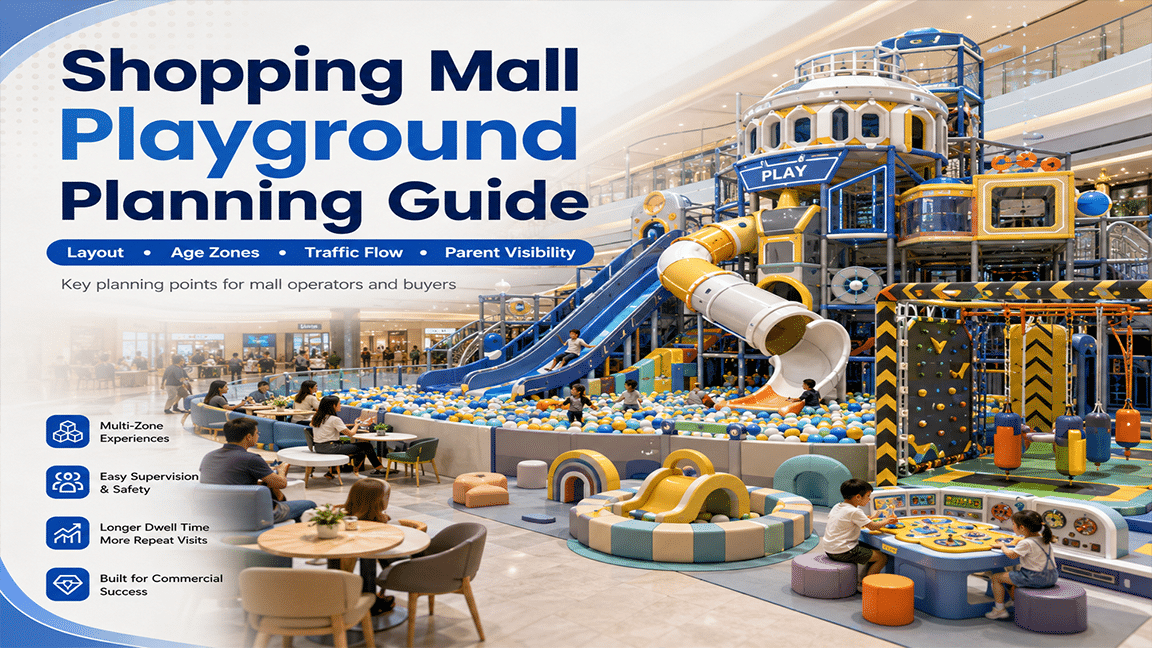
Parents should be able to see their children at any time. The seats should be placed in a place where every corner of the children’s area can be seen. Columns or equipment should not block the view. Parents will not stay or come again if they can’t see their children.
Children need enough space to move around and can’t bump into each other. Each person needs about 12 to 15 square feet, and leave at least 1.2 metres of passage between the amusement equipment. The place is too small for children to bump into each other, and parents will not feel at ease.
Toddler playground equipment is tossed by children every day. The high-density non-toxic foam can withstand the impact, and at the same time, it feels soft. With a layer of durable PVC on the outside, the foam is not easy to break, and it is convenient to clean. All materials should be non-toxic and flame-retardant.
Children can get dirty, drool, spill things, and sometimes have accidents. The surface should be easy to wipe and convenient for disinfection. Materials such as PVC are suitable and stain-resistant. Just wipe with a mild disinfectant.
Commercial-grade materials can hold up. High-density foam can absorb shocks and is not easy to deform. Heavy PVC is tear-resistant, stain-resistant, and wear-resistant. Galvanised steel frames will not rust. All materials must be non-toxic and flame-retardant. This is the requirement of the ASTM F1918 standard. Be sure to check for a valid test report before buying. Does the real material really comply with ASTM F1918 or EN1176?
| Area Type | Application | Equipment | Recommended Space |
| Compact | Café / Daycare | Mini slide, soft blocks | 80–150 sq ft |
| Medium | Indoor Playground | Ball pit, soft climbing | 15–20% of total playground area |
| Large | FEC / Mall | Multi-activity soft play | 250–400 sq ft or more |
The children’s activity area can be calculated by a relatively general algorithm. Each child needs about 12 to 15 square feet of space, which is about 1.1 to 1.4 square metres. For example, if this area can accommodate 10 children at the same time, the activity area itself should be at least 120 to 150 square feet, which is 11 to 14 square metres, and this does not count the aisle and the place for parents to sit.
Young children develop rapidly, and there is a big difference between 18-month-old and 4-year-old children. For children from 0 to 2 years old, the equipment should have rounded corners, no need to climb, sensory panels, and a ball pool accompanied by adults. For children aged 2 to 4, they can add gentle slope slides, low climbing frames, and interactive panels.
Safety cannot be compromised. It is necessary to confirm that the equipment meets the ASTM F1918 or EN1176 standard. The edge should be smooth, the ground should be cushioned, the material should be non-toxic, and the maintenance should be convenient. It should be easy to clean and replace parts.
Modular equipment can be started from a small size, and then add things slowly when the business is good. There is no need to replace the whole structure, which not only saves money but also adjusts flexibly according to the needs of guests.
Modular equipment can be started from a small size, and then add things slowly when the business is good. There is no need to replace the whole structure, which not only saves money but also adjusts flexibly according to the needs of guests.
Modular equipment can be started from a small size, and then add things slowly when the business is good. There is no need to replace the whole structure, which not only saves money but also adjusts flexibly according to the needs of guests.
The place is small; there are too many people, and the children are easy to bump into each other and cry. Parents take the children away in advance. Each child should have at least 12 to 15 square feet of space, and the number of people should also be controlled.
Children are easy to get dirty. If every corner can’t be wiped, the area will be dirty and smelly. Parents can see it at a glance. There should be a passage behind the equipment, and the material should also be wiped.
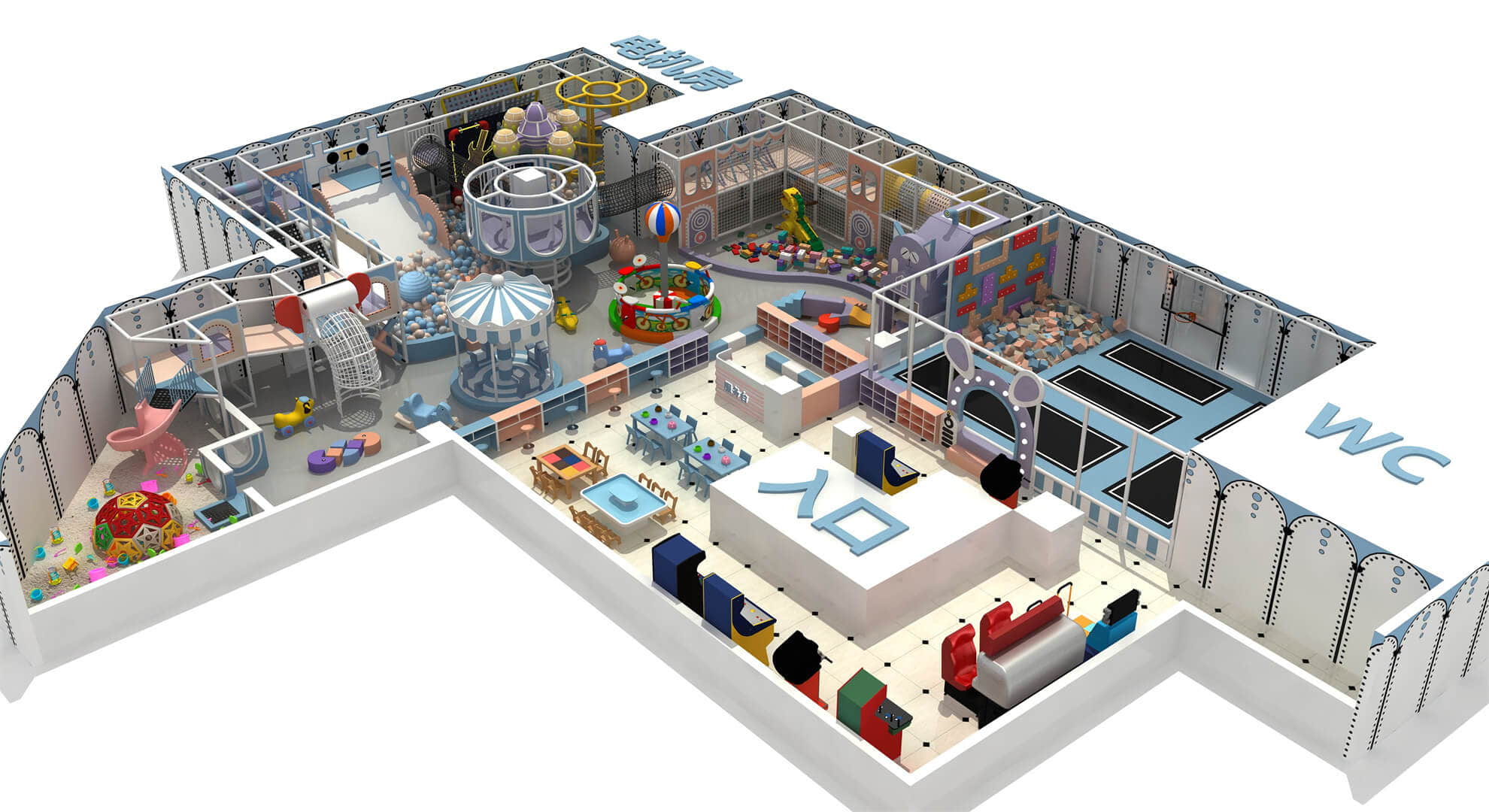
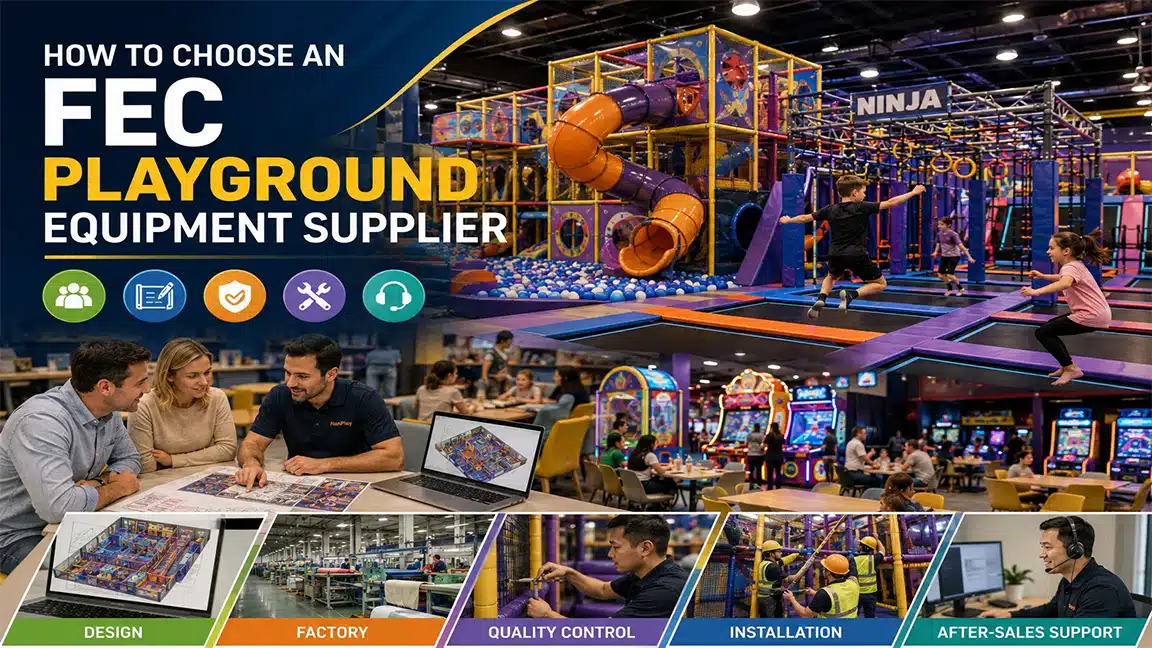
The project starts from the floor plan of your venue. The manufacturer will first look at the size, column position, ceiling height, and exit channel. This step is to confirm that the design can be placed in your space before the equipment can start production.
The professional design team will first make 2D layout drawings and 3D renderings. Before production, you can see what the children’s area looks like. You can clearly see where the slide, ball pool, and sensory panel are placed. If you think it is inappropriate, you can change it at this time.
After the design is decided, production begins. The equipment is made of commercial-grade materials in the factory, and there is quality inspection at each stage to ensure that the finished product is in line with the design.
After the equipment is packaged, it will be sent to your site. The manufacturer will provide installation manuals, step-by-step drawings, and video guidance. Just follow them. If the project is relatively large, they can also send a professional installation team to the site to install it.

Soft package amusement structure, small slide, gentle climbing frame, ocean ball pool, soft building blocks, sensory wall, and interactive activity panel are all available. Everything should be low and wrapped in soft bags.
The best toddler soft play equipment uses high-density, non-toxic foam, with a layer of durable and easy-to-wipe PVC on the outside. It should be low in height, absorb shock, have no hard edges, and also meet the ASTM F1918 standard.
The smaller one, 80 to 150 square feet, is suitable for cafes and nurseries; the medium one, which accounts for 15% to 20% of the total area of the playground, is suitable for indoor playgrounds; and the larger one, more than 250 to 400 square feet, is suitable for family entertainment centres and shopping malls.
Place it near the entrance and the parents’ seating area, so that parents can easily take care of it when they sit and rest, and at the same time stay away from the active areas of the trampoline and the exploration structure.
The equipment should be suitable for the target age group, confirm that it has ASTM F1918 or EN1176 safety certification, and the materials should be durable, non-toxic, and easy to clean. Find a manufacturer that can provide customised design and installation support to cooperate with.
The design of the children’s play area is not only about choosing a few cute-looking pieces of equipment. It should be a safe and fun place for children to explore, learn, and play in. At the same time, parents can also relax and know that their children are safe.
First of all, the age group should be clearly divided. Children and older children should be separated. The equipment should be low, and the surface should be soft. Parents’ eyesight should be prioritised. The materials should be easy to clean. Commercial-grade materials that meet the ASTM F1918 or EN1176 standards should also be selected.
NanPlay provides customised children’s play area design, soft package amusement equipment, and commercial playground equipment. From floor plan viewing, 2D and 3D design, production, transportation, to installation, the whole process can be included. Contact NanPlay now and start designing your children’s play area.
Thank you very much for your inquiry! Your trust is our greatest motivation. We are committed to offering playgrounds that combine high quality with affordable pricing. Let us bring vitality to your venue!